Heat had a texture in the garage—a damp, heavy weave that clung to her arms and face. Turpentine and linseed oil hung in the air so thick that breathing and not-breathing had flattened into the same dull ache. At her feet, the bottles: mineral spirits, acetone. The hotplate’s cord curled under the workbench, and the coil glowed orange. Sunlight pierced the window, a slow spear aimed at the acetone can she’d left on the sill. The metal sweated. She watched the light crawl; in half an hour, the fumes would find the hotplate. Her body would decide by then. Her body was already deciding: her lungs pulled the chemical air without her consent, her heart beat a thick, stubborn rhythm.
The gravel. The threshold. A line of white light. Beyond it, the street. The moment her eyes found that line, the spot between her eyebrows began to burn. Pins and needles. Memory resurfacing this time not as an image but as a pressure: of the cold circle of a muzzle, dragging across her forehead, settling on the bridge of her nose. The black O. The rotting eggs and ozone, the click of a hammer, louder than any shot. The shot hadn’t come, of course. But she was still there, part of her, still braced, still waiting. If she braved the driveway, the waiting might finally end.
Or the street would finish what the muzzle started.
Her gaze tore from the deserted street and found her paintings. Six canvases lined against the back wall like friends on a bench. Oil paint didn’t dry—it cured, a slow chemical cross-linking that heat accelerated. Cambridge’s usual damp left the layers gummy for months, a banquet for mold. But this heatwave, this freak furnace, could harden them in days. Without it, she knew, the eventual varnish would bloom white. Months of work undone. Months more of watching her own hands shake over a palette while the Reich counted her ration points and told her when she could walk to her own front step.
Fuck this shit.
Not indignation, rage. Indignation was a parlor word for women with sugar bowls and intact nerves. This was a black, wet hemorrhage in her chest, a pressure that pushed against her ribs and blurred her vision. She’d given them the street. She’d given them her father and Oma Jeanette, her sleep, the idiot assumption that a knock meant a neighbor. The doglike reflex to trust a stranger’s face. The nursery-room lie that rules ran both ways, that effort and outcome were bolted together, that the place she lived was actually hers. She’d given them her capacity to be shocked by cruelty, that last untouched scrap of herself. Her memory of herself as whole. Her ragged, stupid conviction that humanity was, at minimum, worth the goddamn trouble.
Fuck the Reich and fuck fucking toast.
The Wind in the Willows when she was nine, Mole catching the scent of his old burrow on the air and falling apart with longing, and Ratty getting the toasting fork and they stood there burning bread over the coals like it was the goddamn Eucharist of Home. Every cozy little beast weeping into its whiskers about onions and butter and the sacred ache of belonging. She’d thought it was beautiful once. She’d underlined it. Now she wanted to find Kenneth Grahame’s grave and spit on it.
Someone was always closing their eyes and breathing in the scent of toast—as if that were the shorthand for everything lost, as if buttered bread were the summit of human longing. She’d read those passages and wanted to spit. Toast. You missed toast when your life was whole enough that toast was what you’d lost. When no one had put a muzzle to your forehead. When your father wasn’t mud. When sleep wasn’t a negotiation with a locked door and a hotplate. The air in the garage was turpentine, acetone, the sweet rot of linseed oil going off—and somewhere, probably, in some intact kitchen across the cordon, there was a slab of bread turning gold over a flame that answered to a living hand. Let them have it. Let them grieve their breakfast. She’d inhaled nitrogen oxide and waited for the click. Toast was a luxury you only missed if you’d never smelled your own rotting foot.
She took the big one.
She knew this was a mistake before her arms had finished tightening—the thing was taller than she was and twice as wide as her shoulders, and she was attempting to lift it with the confidence of someone who hadn’t lifted anything heavier than a tea mug in almost two years. The canvas had been propped against the back wall of the garage for a month, gathering dust and a sort of resentful inertia. She got her hands on the stretcher bars and it pushed back. A bag of flour, a wardrobe that’d had decided it was a load-bearing wall. She shifted her grip and the bottom corner swung into her shin.
And made a noise like a stepped-on accordion and staggered sideways. The top corner, now unmoored, described a slow, fatal arc toward the hotplate. She lunged and caught it with her hip. The hotplate wobbled. The acetone can, which had been minding its own business, received a gentle nudge and did a full, disdainful 360-degree spin before settling again with a click. She exhaled. The canvas, apparently satisfied with its opening gambit, leaned its full weight against her chest and began a slow slide toward the floor. She hooked her chin over the top rail and held on. This was not a technique she’d learned at the MFA School. Her arms were spread too wide, fingers crimping white on the bars, the canvas now covering her entire front like a very large, very damp sandwich board. She couldn’t see her feet. She could see, at the extreme periphery of her left eye, a blur of stacked frames and a bucket of gesso that she was now, for reasons she didn’t care to examine, circling.
The floor existed, she knew that much, but where it was in relation to her feet was a problem she had to solve blind. Shuffling forward, chin hooked, arms crucified, the canvas dragging its bottom edge along the concrete with a long, slow skid. A corner found the workbench immediately—it had a gift. She stopped, adjusted, threw her hip into a counterbalance that felt almost balletic, and the opposite corner drifted straight into the wall. The impact cracked something—a skin of dried pigment splitting open, a bead of umber welling up like blood from a scratch that should’ve healed months ago. She made a small, tight sound at the back of her throat and corrected with her forehead. The bead oozed onto her shirt, another entry. Her shirt was a sweat-logged CV of every painting she’d wrestled in this garage, and the red streak was the latest entry.
The garage door was a narrow rectangle of searing light. She aimed for it. Her hip found the workbench again, in the same spot, and she barked a single syllable that would’ve gotten her mouth washed out with soap if Oma Jeanette had still been here. She shuffled faster. The canvas, sensing the outdoors, began to pull left. She countered with her right knee. They reached the threshold in a sort of violent, stumbling waltz, and then she was outside, the gravel skittering under her shoes, the sun slamming into the back of the canvas and radiating straight through onto her face and she’d done it.
She was out.
The gravel laughed.
She didn’t feel it as hurt, not now. The part of her that could be wounded by what are you going to do with that got burned out somewhere between the last aspirin and Rainsford Island. The adults in the room, all of them—Constance, Mrs. Chen, the ones who understood real life. Responsibilities. Unlike Charlotte, for whom cholera was mere metaphor! Lost in her studio, staring into space when she could be throwing a tantrum. Letting the world know it was wrong, like someone’s mother sending back an entrée. Apocalypse was not on the menu. The fury of this stupidity—this infantile, foot-stamping assumption that the scale of the evil depended on her performing the correct response, as if the Reich’s moral architecture required Charlotte’s wailing in the street to be properly condemned. As if genocide were a dinner party and someone had simply forgotten the fish course. You didn’t send it back. You didn’t ask for the manager. The manager was dead. The manager had put a gun to your forehead and clicked. The horror didn’t need her to testify to be real—it was real, it was in her lungs, it was cooking off the acetone on the sill whether or not she put down her brush and started rending her veil like a widow in a woodcut. Let the world know it was wrong—the world knew. The world had always known and had yawned and turned the page.
That wasn’t a failure of messaging. That wasn’t a shortage of theatrical grief.
Moreover, “waste of time” only made sense as a charge if time was a currency you hoarded for something more important. But in a genuine collapse—not a recession, not a rough patch, literal Armageddon—the utilitarian calculus that called art frivolous ate itself. If survival was the only value, then everything that wasn’t calorie acquisition or threat avoidance became waste. Friendship was waste. Singing a song was waste. Telling your child a bedtime story was waste. Grieving your dead was waste, because the dead didn’t require calories and your crying burned energy. You could follow that line all the way down until you’d reduced yourself to a digestion tube with a fight-or-flight reflex, and you’d still die. Maybe slightly later. But what exactly did you preserve?
The “you can’t eat it” argument assumed that humans were organisms that sometimes made art, rather than organisms for whom art-making was as diagnostic of the species as tool use or language. You found cave paintings before you found evidence of agriculture. You found carved bone flutes in the middle of ice ages. People in active war zones wrote poetry on scrap paper. Prisoners scratched images into walls with their own fingernails. This wasn’t a luxury they indulged once the danger passed; it was coeval with the danger. The thing they did while starving, while hiding, while dying.
The making was never separate from the surviving. It was part of the mechanism.
A human being was not a metabolism that occasionally doodled. A human being was a pattern of meaning-making that required a metabolism to keep running. Remove the meaning-making, the metabolism stopped being worth the trouble. People who lost the sense that anything mattered—that their actions connected to a narrative, that their suffering had witness, that something of them would persist—stopped eating. Stopped fighting. Laid down and waited. Art was get up again, the conviction that persistence was warranted. Not the dessert after you’d secured the main course, the reason the main course was a course at all instead of just an animal chewing.
Then there was the time horizon problem.
“No one’s buying portraits” assumed that the only audience was now, the only market was currency, the only function was transaction. But art addressed itself to a future that might or might not arrive, which was precisely the thing you needed to believe in if you were going to bother surviving in the first place. The very act of making something durable sent a signal—to yourself, to whoever found it later—that there’d be an after. That, Constance, was a rational act. And what was Constance doing? A lot of hand-wringing, while Mrs. Chen hoarded. Making the thing is not less productive than marinating in your own anxiety, Connie. Neither was filling old milk cartons with used Reynolds Wrap.
Leaving Charlotte to waddle, alone, down a path stretching into eternity.
Above, leaves hung motionless, each one a small dark hand cupped around a portion of silence. The herringbone of the sidewalk vanished into the distance beneath alternating bands of that bone-light and velvet-dark, a pattern uninterrupted by any footprint, any fallen leaf, any disturbance at all. Curbs clean granite ledges, a straight and unbroken seam and where the sun struck them directly, they gave off a pale, powdery glare, the kind that left a fine residue on the retina. A mathematical plane rendered in lime and aggregate, leading nowhere. Every surface—the asphalt, the brick, the clapboard siding—seemed to hold its breath, a faint, throbbing expectation pressing inward from all directions, something felt more in the bones behind the ears than heard. Stirring a slow, soundless wake, a disturbance without echo, sealing up behind her as she passed.
Clapboard colonials watched like the mausoleums they’d become, paint a chalky flatness, white and pale yellow and faded blue all subdued under the same pallor. Windows become sheets of dark glass reflecting nothing but the pale dome of the sky and the motionless street. No curtain stirred, no shadow moved across a wall. The glass didn’t simply block the interior; it erased it, presenting a surface so unrevealing that the houses seemed uninhabited not by absence of people but by a deeper kind of vacancy, a lack of the very condition in which life might occur. The porches were bare planes of sun-bleached wood, their floorboards separated by gaps holding only a darker grade of shadow. The brass knockers on the doors had a warm, dull gleam, the glow of metal that’d absorbed hours of sunlight without once being lifted or touched, and each one hung against its strike plate with a small, final stillness, a period at the end of a sentence no one had spoken.
On its pole by the curb, the gray utility box had gone cold, the metal casing was the color of old ash, and its small round meter held a dial no longer moving in intervals that could be counted. The transformer inside was inert iron and copper, its coils silent, its core no longer humming with the sixty-cycle note that would’ve been felt more than heard. The air around the box was indistinguishable from the air anywhere else—thick, static, particulate. No pulse radiated from the casing, no faint vibration traveled down the pole into the concrete below. The thing had ceased to be a source and become merely an object, another surface collecting the same fine film of the afternoon, its shadow a short dark block on the sidewalk that shared its stillness with all the others.
The heat continued to rise from the road, a slow, ceaseless respiration that asked nothing in return. The air remained where it was, each particle suspended in its place, and the silence lay across Ash Street with the even, impenetrable texture of something that’d been settling for a very long time.
Then—stone turning, ankle turning with it, a bright twist of heat through the tendon. Her stomach dropped, her inner ear reeling, equilibrium gone, the whole vertical world sliding sideways. The painting left her grip, and the sudden lightness in her fingers registered as its own small shock. Her arms shot forward, hands opening to break a fall that was already underway. The gravel rose, each pebble distinct, rushing up to meet her, the lake bottom smell filling her nostrils, the heat of the stones radiating against her face until hands closed around her waist.
The grip was hard and immediate, fingers wrapping the curve of her hipbones, palms flattening against her belly and the small of her back. Her forward motion stopped dead, her own weight yanked against the grip, organs shifting forward inside the cage of her torso. Opening her mouth to scream, her breath jammed in her throat, arms still stretching toward the gravel, fingers splayed a foot above the stones. And for a stretched moment she hung there, suspended, the ground still exactly where she’d been falling toward it, her blood still rushing with the expectation of impact, the inner ear still spinning its useless report. The hands held. The heat of them came through her shirt, a human warmth that registered only after the fact of the grip itself, and her breath came back in a single sharp pull that was half gasp and half sob.
She was already twisting when the flat, dust-puffing slap of the canvas hit the gravel—the sound of linen and wood slamming shut like a door. The hands let go, a release so clean it felt like a reflex, leaving her to stumble forward into the space their grip had made. Pebbles skittered under her shoes. Her arms wheeled once, found air, and she caught herself with a jolt that ran up through her shins and settled in her teeth. She straightened, hand pressed to her mouth. And uncoiled. The fear struck her lower back, a sharp kinetic command that whipped her hips and spine around to face the dark mass of him, her breath hitching all over again as she forced herself to face the threat.
His uniform was the black of a system that’d weighed every other color and found them insufficient. The tunic was serge—heavy, dense, the nap ironed flat by an iron lifted and lowered, lifted and lowered, until the wool had been persuaded into a surface that returned only the memory of that pressure. No warmth, no give. The shoulders squared off, the chest ran flat, the waist was cinched with a severity that implied the body inside had been disciplined to the uniform’s dimensions. Sleeves set into armholes without a ripple, the seam a clean line from collarbone to deltoid, straight as a ruled edge. A column of silver buttons climbed the front, each a convex mirror polished to a cold gleam.
A collar high and banded, the black wool fitted as though cast, closed tight at the throat and pressed against the Adam’s apple. On the left collar tab, three silver pips and a single stripe—Hauptsturmführer, she’d learned that on the news. But his right collar tab bore no sig-runes, no unit number, no cypher. Just a blank square of serge, nap unbroken, weave running uninterrupted from edge to edge. A decorated no one: over the left breast pocket, the Iron Cross hung from its black‑and‑white ribbon, the silver frame and black iron center stark against the tunic.
Belted at the waist, leather strap the width of a hand or a restraint. Pulled taut, the buckle a square of silver engraved with the motto Meine Ehre heißt Treue. My honor is loyalty. The letters were raised, crisp, each one a small monument to the proposition that honor and loyalty were the same thing and that both were made of metal. The leather had been worked until it was supple without being soft, pliant without being yielding, a material that had learned to move with the body while remaining, at all times, a reminder that the body was to be contained. The holster hung from the right hip, the black flap of the Luger’s housing rising from the leather with the quiet, patient expectancy of a thing that’d been waiting longer than she’d been standing there.
Jodhpurs ended at the knee, the place where wool met leather, boots rising like a carapace. Polished to a depth that held the world in their surface, bent around the curve of the calf: the windows, the chestnuts, the figure of Charlotte herself, swallowing—all of it caught in the convex mirror of the leather and returned small, far away, a diorama of a world that had already been reduced to the size of an incident and women were seen, acted upon, decided about. The shift happening not in movement but in the sudden absence of scatter—every micro-adjustment, every incidental drift of attention draining away, leaving a single vector fixed on her with the impersonal stillness of a lens finding its focal depth. His head settling into a minute angle that somehow subtracted warmth from the street’s geometry, and the eyes stopped their ordinary skimming to enter a sustained, unblinking rest that felt like a second set of fingertips laid directly on the nape of her neck. Her body registering it before her mind could name it: a cool descent across the shoulders, then the fine hairs along her forearms lifting in that ancient, involuntary response to a presence that’d stopped regarding her in the round and begun tracing her perimeter with a quiet, undivided pressure. The threat wasn’t display—no tension, no bared intention—it was the interest itself, radiating outward in a constant low frequency that turned the air between them into something that held still, and waited.
But she wasn’t some collection of entry points. She wasn’t a soft belly, a space between the legs, the back of a neck where hair lifted. She wasn’t access. She wasn’t a site of violation waiting to happen. She knew—with a clarity that cut through the fear like a scalpel—that to describe her fear by describing her body, to linger on the places where she could be entered, touched, broken, was not to describe her fear at all. It was to rehearse the violation from the violator’s perspective. It was to turn her into a topography of harm while claiming to care about her interior. It was to do the thing it claimed to be naming. He had done that. The world had done that. She had been trained to do it to herself. But she was not a collection of entry points. She was a person. She was afraid. And her fear was not an invitation to imagine what could be done to her.
Ash Street’s last inhabitant, alone with a man with a Luger.
The crown of his Schirmmütze rose in a stiffened dome of black wool, the band a strip of black velvet that wrapped the forehead with a different darkness, a softer darkness, a darkness that held the suggestion of luxury and the consequence of it. Centered on the band, the Totenkopf. Silver, struck from a die, the bones of the jaw laid bare, the teeth bared in a grin that was both greeting and verdict. The eye sockets were hollow and dark and fixed on a point behind her. The angle of the skull was tipped just slightly, a fraction off true, like she’d caught it in the middle of a private joke, a joke that’d been told before she arrived, a joke that was about her, a joke whose punchline was a shallow grave. Visor sweeping out above it in a gleaming crescent of black leather, casting a band of shadow across the upper face. Watching her, from somewhere underneath.
The SS was a death cult.
Not the collateral, for them, not the regrettable necessity, not the price of war—death was the point. Their so-called ideology was a scaffold bolted around mass murder. The bureaucracy was the plumbing: pipes and valves and men with fountain pens directing the flow of bodies to the places where bodies became ash. The uniforms, the oaths, the runes, the belt buckles with their little mottoes—all of it costume jewelry on a machine whose only output was obliteration. The vestments were bones, the language a litany of scrubbing verbs. The enemy was a stain, and the removal was its own justification, a hygiene that answered to nothing but itself. The scale of it was industrial: men in warm rooms calculating the burn rate of a human being, a child’s shoe in a ditch, a pit that smoked for days and left a grease on the air that stuck to the back of the throat.
Meine Ehre Heißt Treue.
This wasn’t a man in a uniform. This was the uniform’s man. The SS had made him, shaped him, pressed him into this shape like someone’s iron had pressed the serge, and what stood before her now wasn’t a person who’d joined an organization but an organization that’d grown a person to wear it. But he wasn’t the first. The black wool, the silver braid, the death’s head grinning its private joke—these had been waiting for him. Waiting for someone. Murder was a lineage, a thing handed down. Through generations, it’d worn other uniforms, carried other weapons, spoken other slogans. But the work was always the same, and the joke was always the same, and the punchline never changed. The decision had been made before the chestnuts were planted, before Ash Street had a name, before anyone could remember a time when there was not some man standing in some street with a shadow where his eyes should be. He was only the newest one. The latest representative. The current face of a thing that had no face, that needed a face, that kept finding faces, that would always find a face, and this time the face was his, and the street was hers, and the chestnuts were in full leaf, and the Luger was on his hip, and the shadow beneath the visor was patient, because the shadow had waited a long time. The shadow knew how to wait.
The shadow spoke.
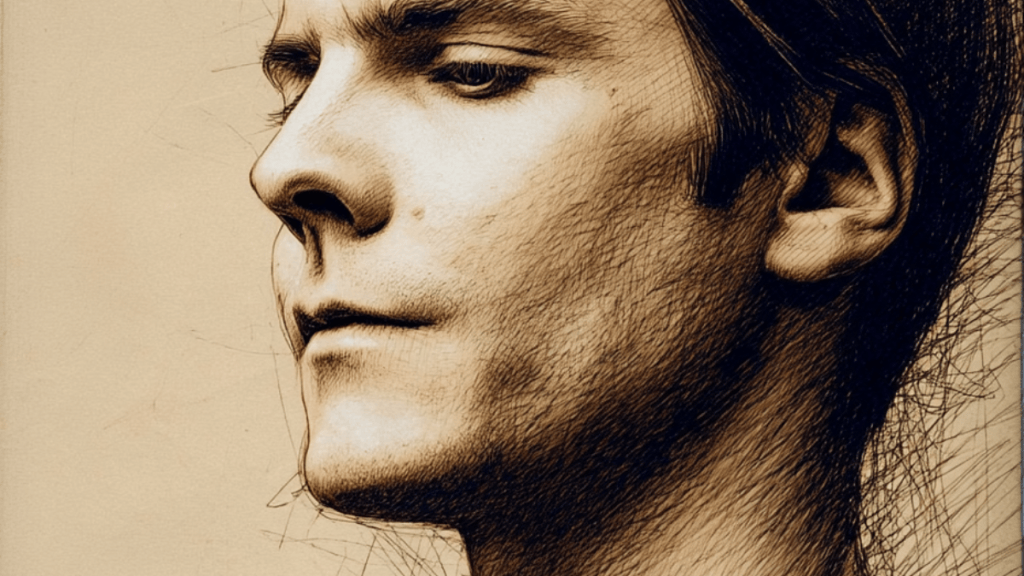
“You almost took a tumble.” His voice carried the precise, articulate crispness of a cultured Ruhr accent—a staccato singsong that bounced not with coarse jollity but with the measured, knowing cadence of a man who chose his words and enjoyed the shape of them. The shadow cast by the brim slid upward and vanished, boot crunching, and where there’d been a darkened hollow there was now simply a face. A distinctly heart-shaped face defined by a broad forehead and high, angular cheekbones that sharply tapered down to a narrow jawline and a slightly dimpled chin. His deep-set, dark brown, almond-shaped eyes featured subtly downturned outer corners, giving his neutral gaze a naturally soft, contemplative quality. Intensity grounded by low, gently arched eyebrows that sat close to his brow bone. A straight, neatly structured nasal bridge and a short, deeply carved philtrum. Lips thin-to-medium with very sharp, well-defined Cupid’s bow and corners that naturally tilted upward, making even a resting expression carry the faint hint of a smirk.
The rat, she reminded herself.
All creatures great and small, even vermin—God’s little compost interns, just trying to gnaw their way through a world that’d never once sent them a memo labeled YOU ARE GROSS. You couldn’t blame them for being vermin any more than you could blame a puddle for being damp. Their brains were the size of lentils that’d given up on its dreams, far too small to accommodate the concept of revulsion, social cues, or the phrase “pardon me, I seem to have misread the room.” If he was about to assault her, he’d have started already. The math on creepy-guy acceleration had never let her down.
Unless.
A dark, Sir David Attenborough-flavored voice slid into her head: “But here, in the dim light of the gallery, we witness a classic case of prey-drive displacement. The cat—for it is a cat, not a rat—has already pounced. What appears to be helpfulness is, in fact, the long, leisurely prelude to a kill. Note the deliberate, almost theatrical retrieval of the painting. The fastidious brushing of the canvas. To the untrained eye, a favor. To the vole, a horror film in slow motion.” Bending over now. Retrieving her painting as foretold. Brushing at it with the tender focus of a serial killer dusting a lampshade, each stroke setting her teeth on edge, her spinal column slowly cinching into a single, unwavering scream. She could almost feel the evolutionary ghost of her ancestors scribbling frantic notes: “Play dead. Feign interest in the brushwork. Compliment his frame choice. There is still time to become too boring to eat.” Unless she lost control and kicked him in the crotch.
Her painting. Hers. And this man—this absolute turnip in a Schirmmütze—was handling it like he’d found it propped against a trash can with a “free” sign. His fingers, which she now dearly hoped would spontaneously detach and scuttle away in shame, were brushing at the pigment with all the tenderness of a toddler “helping” a wedding cake. Did he think he was dusting a shelf? That this was some kind of participatory exhibit? Please touch the art, but only if you have the vague, sweaty confidence of a man who’s never once been corrected.
What did this psycho know about art? He probably thought chiaroscuro was an appetizer. That impasto was a small Italian dog. Here he was, a man whose entire aesthetic philosophy could fit on a bumper sticker that just said I KNOW WHAT I LIKE in Comic Sans, presuming to lay his damp little paws on something she’d bled onto a canvas. Fingertips grazing the surface, leaving microscopic oils of mediocrity all over her brushwork. She watched a thumb—a blunt, oblivious thumb—hover perilously close to a corner she’d overworked three times. It was like watching a hippo attempt origami. The sheer, unearned familiarity of it. His hand was on her painting the way a tourist’s hand lands on a priceless monument, not in awe, but with a proprietary “I’m here now, so this is mine” condescension. The painting would need therapy. She’d need therapy. And somewhere deep in the Serengeti of this man’s empty skull, the Attenborough voice narrated calmly: “The male, having mistaken a gallery for a petting zoo, performs what he believes to be an act of connoisseurship. It is, in fact, an act of vandalism. The artist watches. Nature is cruel.”
She crossed her arms.
He smiled.
With the unearned confidence of a man who’d clearly never once been clotheslined by karma, he smiled.
It was, objectively speaking, a catastrophe. The kind of smile that short-circuited righteous fury and replaced it with something much more inconvenient. The corners of his mouth—already tilted upward in that insufferable resting smirk—lifted just enough to transform his face from a study in sharp angles into something warm, almost boyish, a crack in the austere façade that let an irritating little sliver of light through. His eyes, those downturned, contemplative eyes, crinkled at the edges in a way that suggested genuine, unguarded amusement rather than the predatory calculation she’d assigned to him. The dimpled chin deepened. The high cheekbones caught the gallery light and suddenly he looked less like a serial killer and more like a poet who’d just thought of a very good line and wanted to share it with her specifically. “This is beautiful.”
Her grip on herself tightened. Leave, she beamed at him.
But she felt it, her carefully weaponized disdain wobbling dangerously, like a drunk flamingo. This was not allowed. A moral sewer in polished boots who manhandled her painting like a clearance-rack throw pillow had no right to smile like that. A man who probably referred to Rothko as “a bit simple” should not be allowed to possess a smile that made her brain briefly, traitorously, forget every single reason she wanted to bite him. It was the smile of someone who’d never been told no by a face they wanted to keep looking at. The smile of a man who knew—knew—that this particular arrangement of teeth and charm had gotten him out of trouble more times than was morally defensible. Who instead of raping and murdering her would now hold forth on the underappreciated genius of Thomas Kinkade, and how true mastery was knowing when to put light exactly where God intended: in the window of a cottage that’d never known sorrow.
She didn’t want him dead—dead was too permanent and far too tidy. She wanted, with the fondness other women reserved for imagining their honeymoon, to brain him with her grandmother’s cast iron skillet: the medium one, not the big one, perfectly seasoned by decades of bacon and familial resentment. The clang would be less a sound than a correction. He’d fold to the driveway like a broken easel, and for one spectacular, holy second, he’d finally stop talking long enough for her to hear herself think.
“Both….” A sweep of his hand. “Your portrait and Richter’s early photo-portraits create a specific kind of distance that isn’t coldness—it’s more like the subject is present but held behind something. In Richter, that something is often the soft horizontal blur that mimics a photograph slightly out of register, which makes the person feel like a memory you’re trying to focus on but can’t quite resolve.”
When he concentrated, the smirk retired to whatever smug little cave it lived in, leaving the face unguarded. The downturned outer corners of his eyes, which at rest lent him that contemplative softness, deepened into something sharper—not a squint, but a subtle drawing-in, as though the world had narrowed to the single point he was studying and everything peripheral had been politely asked to stop existing. The low brows dropped a fraction of a millimeter, knitting just enough to carve a vertical crease between them, a fleeting architect’s line that vanished the moment he relaxed. His mouth, usually riding the edge of a smile, pressed into a flat, almost stern line; the sharp Cupid’s bow tightened, the lower lip tucked slightly under, dimpled chin set as if he were biting down on a thought he hadn’t finished tasting. The sharp cheekbones caught the light differently now, harsher, all the boyish warmth drained and replaced with something older, more methodical. He looked less like a poet who’d just thought of a good line and more like a mathematician facing an equation that’d insulted his intelligence. The effect was irritating. Against her will, against every righteous instinct she possessed, the man looked almost tolerable. “Maybe its in how the gaze is handled,” he mused, “or how the paint describes the face without fully settling on it—but the emotional result is adjacent: an intimacy that doesn’t give itself away completely. The viewer is invited close, then stopped just short of full access. That’s the shared territory. Not technique, not style, but a kind of quiet withholding in the presence of a human face.”
And she—
For a moment his words remained only shapes, wondrous but loosely woven, their intervals permitting her to retain, in fragments, the man she’d already made of him. She waited for the observation to exhaust itself in its own cleverness; for the borrowed phrase, the little vanity of attribution, the almost imperceptible turn by which her painting would become an occasion for him to admire himself. Somewhere he would betray the poverty she’d assigned him. She needed only to wait.
But the shapes drew apart, and the space behind them wasn’t empty but new, and it had a pulse.
She couldn’t look away.
An intimacy that didn’t give itself away completely. She’d never said it so. In the garage it’d been a difficulty of paint, a matter of bringing the face forward without surrendering it to the merely visible, then scraping it back when the likeness acquired that dreadful sufficiency by which a thing could be recognized and no longer seen. She’d worked until she could no longer distinguish what the painting required from what she herself could bear. The distance remained. She’d left it there, unresolved, and he had entered the room and spoken of it as though its silence had a contour.
Now she stood in the hush of the afternoon light—the same light shining on their bombed-out world—and stared into that newness until her hopes and fears became a single hum between her ears. Underneath it the garage returned, the air smelling of turpentine and loss, the retreat she’d already made opening around her with the terrible fidelity of a place remembered by the body. There she was again, absorbed in something she couldn’t name, believing her solitude complete because no one had witnessed it. Yet here was this man, finding in the finished surface the shape of an absence she’d inhabited for weeks.
The world tilted.
The load-bearing wall of who she’d known him to be turned to sand and sloped away, and she was standing on it, sliding, still reaching for the structure as though the gesture of reaching might restore its integrity. His presumption, his smile, that blunt thumb above the canvas: each remained available to her, exact and damning, but the arrangement that had made them conclusive was gone. Help, I’m losing, and she couldn’t supply the object without enlarging the loss; help, I’m falling, though outwardly she stood quite still. Life was silent. The earth’s siren song grew.
Something had cracked, and through the fracture came no revelation she could consent to, only this altered depth in what she’d thought herself finished seeing. Wondrous but loosely woven. She stared and stared. The sounds were deafening and time was frozen, his last words still holding open a space she had neither invited him into nor known how to enter herself. Every day started and ended in sunlight, and this one had too. Nothing in its beginning had foretold a departure from the ordinary jurisdiction of her own mind. So how had she gotten here, into this open water? She wasn’t okay. She wasn’t anything. She wasn’t even the architect of her own anger anymore.
And that at least had been a shape, a room she could pace inside.
The Attenborough voice, somewhere behind her, adjusted its narration: “The male, sensing hostility, deploys a disarming smile. A classic evolutionary tactic. The vole, despite its better judgment, feels a flicker of aesthetic appreciation it immediately resents. Predator and prey draw closer. The outcome remains uncertain, but the vole’s fury has been, regrettably, diluted by the male’s cheekbones.” She wanted to kick him in the crotch twice as hard now, just to compensate—which would need some athleticism, because he was tall, and a shrimp like her lived in a world of giants, but he had to be six feet, though those boots made it hard to tell, and his build was somewhere between a boxer’s and a ballerino’s, the shoulders broad and dense with the promise of impact, the carriage so light it seemed to float above the fact of its own violence, the kind of body that would see the kick coming before she’d even decided to throw it.
I am a ghost. This is a dream.
She could suggest he visit a brothel. Plenty of those around, he’d certainly proven his men knew how to make one—Congregation Eitz Chayim had been such a lovely renovation project, the pews pushed aside for mattresses, the ark draped in something more practical than a parochet. Very enterprising. Very adaptive reuse. And really, what was she getting so worked up about? Lots of women were interested in Nazis. The uniforms, the pageantry, the whole Nietzschean death-cult mystique—it had a market. Some women went in for it quite enthusiastically, even on purpose, and far be it from her to yuck someone else’s yum. She simply wasn’t one of them. A personal failing, no doubt. A lack of imagination. She’d somehow never developed the fantasy of being bent over a Torah scroll by a man whose ideological commitments included performing meditation and neo-pagan rituals to project psychic energy. Call it a character flaw.
He looked down at himself, as though just now registering what he was wearing. The silver death’s head. The immaculate black wool. The whole exterminatory-chic ensemble. He regarded his own chest with the faint, puzzled tenderness of a man who’d found a gravy stain on his lapel and couldn’t for the life of him recall ordering anything au jus. Oh, this. Yes, she could see the thought arriving, slow and sheepish: the uniform might, by some stretch, be interpreted as hostile. A little context-dependent. A little you had to be there. Perhaps he’d simply forgotten he had it on—happens to the best of us, really, one minute you’re dressing for the office and the next you’re a walking monument to industrialized murder. Heavens, how awkward. She had half a mind to offer him a shawl.
He remembered his manners. She could see it happen—the thought drifting down through the layers of breeding and military protocol like a feather through still air, landing soft. One simply introduced oneself. He clicked his heels, a crisp little report of leather on leather, and inclined his head at the precise angle that conveyed respect without conceding a millimeter of rank. “Gestatten Sie. Hauptsturmführer Klaus Dassel.” The name arrived with its own puff of self-importance: Klaus, sharp as a cat’s sneeze, and Dassel, which sounded like a minor noble house that’d done something vaguely embarrassing at the Congress of Vienna and been quietly asked to leave. He offered it to her as though it should mean something, this tidy little envelope of syllables, as though the formal presentation of a name might retroactively launder everything stitched to the uniform beneath it. Manners. Breeding. The works. She half-expected him to produce a calling card, pressed between two immaculate fingers, the paper bone-white and unsullied by anything so gauche as a bloodstain.
Her mind, at that moment, was bees.
Not a thought. Not a feeling. Just bees. A whole hive of them, humming along in the dark of her mind, doing whatever bees did—pollen redistribution, hexagonal architecture, the occasional sting—with no reference whatsoever to the fact that an SS officer had just introduced himself in her driveway. The bees didn’t care. The bees were above politics. They were just there, industrious and golden and utterly indifferent to Hauptsturmführer Klaus Dassel, which was more than she could say for herself.
He paused. The charming face—that carefully arranged collision of cheekbones and jawline—flickered with something almost imperceptible. A tiny diagnostic query. Had she not understood? Was her German insufficient to the task of appreciating his performance? He seemed momentarily lost, a Prussian noble whose genealogical pedigree had, for the first time in its centuries-long march, failed to induce panty-dropping on contact. Confusion settled into the elegant architecture of his brow. He recalibrated. Switched to English. “I am Hauptsturmführer Klaus Dassel,” he said, slower this time, louder, as though she might be not merely foreign but also hard of hearing.
The bees, unimpressed, continued their work.
“I’m charmed,” he said, and waited.
She was not charmed. She was not, in fact, even the general neighborhood of charmed. Charmed was a continent she had never visited, whose language she did not speak, whose culinary traditions she had no interest in sampling. She stared at him. He knew too much about art—that was the problem. Or rather, one of the problems, a minor tributary feeding into the great river of problems that was his entire existence. He’d painted something once, maybe. Or paid someone to paint it. Or slept with twelve painters, stolen their secrets, and left them weeping into their palettes. However he’d acquired his taste, it was real, and it was wrong, because a man who looked like that and wore that repulsive parody of a uniform and had just clicked his heels like an extra from The Nutcracker awaiting a dance card had no business knowing a Titian from a turnip. And yet.
“And you are?” He leaned in slightly, the smile still in place, a man who had never once been denied a lady’s acquaintance and saw no reason to start now. “The pleasure of your name, Fräulein?”
She stared.
Under the fence at the edge of the driveway, a rat paused mid-squeeze. It’d seen many things in its time—urine, opportunity, the occasional cat with delusions of competence—but this was new. A man carved from an advertisement for Aryan dentistry, leaning toward a woman who appeared to have turned to stone. The rat waited for something to happen. Nothing did. The man kept smiling. The woman kept not-smiling. The silence stretched until even the rat, a creature famously unbothered by the rhythms of human stupidity, found itself growing restless. It had things to do. Dumpsters to investigate. Smaller rats to disappoint. With a final twitch of its whiskers—a gesture that might, in a more generous species, have been read as a shrug—it squeezed the rest of the way under the fence and left them to it, whatever fool’s waltz this was.
She dug her Kennkarte out of the back pocket of her jeans and held it out. Not politely. The gesture came with a flick of the wrist that slapped the space between them, a little backhand to the air, as if to say: here is my government-issued identity, here is the box into which your kind has sorted me, now look at it and then leave. The booklet hung there, pinched between two fingers that wanted nothing more than to release it and let it drop to the ground so she could step over it and walk back into the garage and close the door forever. Every angle of her body leaned away from him. Her chin was up. Her weight was on her back foot. If disdain were a language, she’d just delivered a sonnet.
He hesitated, the Kennkarte suspended between them like a live grenade. She could see him deciding—to acknowledge the hostility, or to steamroll through it with the relentless good manners of a man who’d never once been asked to leave a room and wouldn’t know how to start now. He chose steamroll. A courageous choice. A stupid one, but courageous. She was a space heater of no, radiating refusal from every pore, and he walked directly into the heat, opened the booklet, and—impossibly—beamed. “Charlotte Wahl,” he read aloud, savoring the syllables like a bonbon. “Born 22 April, 1973.” He paused, doing the arithmetic. “Ah—you’ve just turned twenty-one.” His smile brightened another impossible watt. “Reichsbürgerin. Well. This is a pleasant surprise.”
Indeed, she wanted to tell him. Born in the United States of America, thank you very much, to parents who’d gotten out at eighteen, two kids with their whole lives ahead of them and a regime behind them that wanted to send them to a camp for the crime of saying God first. Purple triangles. Conscientious objectors. The kind of people his ideological ancestors had worked to death, or starved to death, or simply beheaded. Reichsbürgerin. She’d been handed citizenship by accident of geography, by the sheer dumb luck. She wanted to tell him all of it. She wanted to watch the smile drop. She wanted to see the real man come out from behind the cheekbones.
She held out her hands, palms up, a little ta-da gesture, as if presenting herself for inspection. Here she was. The great American miracle. Her face was a masterpiece of deadpan—no smile, no warmth, just two flat eyes and a mouth that knew exactly what it was doing. The hostility wasn’t in the words. The words were practically a shrug. The hostility was in the stillness, the way her hands didn’t waver, the way she held the pose just a beat too long, inviting him to look, to really look, to compute the arithmetic of her existence and arrive at the sum of his own irrelevance. I’m American, the gesture said. What are you going to do about it, you black-clad son of a bitch.
He paused. Not the diagnostic little flicker from before—this was a real pause, a full stop, the kind of silence that had weight and texture and a small, frightened heartbeat. He recalibrated. She could see the machinery working behind his face, the tiny gears of charm and condescension grinding to a halt and then starting up again in reverse. He cleared his throat. It was a delicate sound, almost apologetic, as though his throat had never been cleared in its life and wasn’t entirely sure it was doing it right.
“I would like,” he ventured, and the words came out carefully, one at a time, like a man placing eggs on a tilted surface, “to make your acquaintance.” His voice had dropped a register. The flirtation was gone. The Fräulein was gone. What remained was a request so earnest, so stripped of his usual artillery, that it was almost—almost—a plea. He wanted to make her acquaintance. This nightmare of a woman with her palms open and her eyes flat and her entire existence a rebuke to everything he wore. He wanted to know her. And he was terrified, she realized, that she would say no.
She took the Kennkarte back and tucked it into her pocket, and somewhere in the small, mechanical act of folding the booklet and sliding it home, something in her softened. Just a fraction. Just enough to horrify her. A terrible impulse, absolutely the wrong impulse, an impulse that would need to be taken out back and shot at dawn—but there it was. She felt sorry for him. He’d paused. He’d really paused. He’d recalculated and cleared his throat and laid his request at her feet like a dog with a dead bird, proud and hopeful and completely oblivious to the horror of the offering. And now he was waiting, and she was the one with the power, and she found she didn’t want it. It wasn’t a good feeling. It felt like kicking something soft. “I don’t think,” she replied, almost regretfully, almost kindly, which made it worse, “that we have much to talk about.”
He brightened. Not the calibrated smile from before, not the diagnostic flicker, not the charm with its dimmer switch set to seduce—this was the real thing, a full-beam, unwarranted, utterly infuriating sunrise of delight. He was so happy. Beaming at her like she’d just handed him a trophy. Like she’d announced the winners and it was him. Him, Hauptsturmführer Klaus Dassel, first prize in the category of Getting Charlotte Wahl to Say a Complete Sentence.
He gestured behind him, to the Second Empire Victorian that’d once been Mr. and Mrs. Clark’s.
The house rose up behind the high stone wall like an empress who’d outlived her empire and was no longer receiving visitors. Second Empire, which meant a mansard roof—that distinctive French slope, steep and nearly vertical before flattening out at the top, the whole thing like a lid forced down onto a box that didn’t quite fit. Dormer windows punched through the slate at precise intervals, each one arched and hooded in black iron cresting that looked like it’d been stolen off a Parisian funeral parlor. Below the mansard, two full stories of salmon brick rose in flat, unapologetic planes, the windows tall and severe and flanked by black shutters that had forgotten what it meant to close. A central tower—because of course there was a tower—shouldered up through the mansard and kept going, topped with an iron widow’s walk that no widow had walked in centuries. The black trim was everywhere: tracing the quoins, banding the cornice, ironing out every horizontal line until the house looked like a drawing that had been inked over by someone who refused to make a single mistake. The stone wall that ringed the property was losing its battle with ivy, and the front gate hung slightly askew, and the flagstones were heaving up from the roots of something old and patient and indifferent to architecture. It was a fortress built by someone who’d once expected to be envied. Now it just expected to be left alone.
“Oh,” he corrected, in that sibilant English of his, the vowels flattened and the consonants clipped. “But we do.” He was practically glowing. “We’re going to be neighbors.”

Leave a Reply