Charlotte stood at the threshold of the garage bay, her left hand resting on the metal rail of the door track, which was cool to the touch and faintly greased in a way that reminded her of machines that still worked. The belt of her painting trousers was cinched to the tightest hole, a hole she’d punched herself with a nail and a hammer last winter, and still the canvas gaped at her waist. She could feel the weight of the fabric hanging from the points of her hipbones, a constant low tug that she’d stopped noticing except when she stood still like this, at edges, looking out.
Ash Street was the same street it’d always been. The chestnut trees on the strip between sidewalk and curb were pushing out their new leaves, that sharp yellow-green of early May that she’d spent whole afternoons trying to mix on her palette—cadmium yellow light with the barest touch of viridian, then too much, then white to pull it back, never quite getting the transparency right, the way the color seemed to float in the leaf rather than sit on its surface. Bud casings lay scattered on the sidewalk below in brown, papery flecks, still sticky if you stepped on them in bare feet, though no one had walked barefoot down this street in a long time. Past trunks still bearing their carved initials she’d traced with her finger as a child—two sets of letters inside a crooked heart, her favorite, K + D, the bark grown rough and widened around the scar. Whoever they were, they’d stood on this same sidewalk with a pocketknife and too much time, and whatever had become of them, whatever long marriage or bitter parting or quiet drifting into separate lives, it’d all been ahead of them then, the whole shape of a future they couldn’t yet see.
Then the air shifted. Coming across the threshold not as wind but as a slow, continuous exhalation, a cellar breathing out after a long wet season. It met her at the back of the throat first, a dry scratch-tickle of carbon and creosote that made her want to cough. Behind the char, rolling up through it like oil through water, came the sweet reek of the sewer main—fecal and rich, with an undernote of something almost floral, the way decay got when it’d ripened long enough. And deeper than both of those, so thin she sometimes told herself she imagined it, the taste of iron. Blood-powder. The dust of something that’d been alive and was no longer.
It coated the tongue and stayed there, no matter how many times she swallowed.
You learned the difference between dead and long dead. Between six hours old and six days. A single corpse behind a closed door was different from a mass grave—sweeter, more concentrated. You learned which smells clung to your clothes and which washed out in cold water. You learned that freezing was a mercy, because it slowed the bacteria. You learned which streets to avoid, not by sight but by shift in the air. You learned that your nose adjusted after a few minutes and most of all, what she hated the most of all? How something unbearable became bearable.
Because the difference between a body that’d been dead three days and a body that’d been dead three weeks was the difference between a street you could walk down and a street you couldn’t. A fresh body meant someone was still alive to die. It meant one of the gangs might still be working the corner, or a fever was moving through a building, or someone was hungry enough to kill. An old body meant the event had passed. The danger had moved on. The street was just a street again, unpleasant but usable. And a bitter laugh escaped her, sucked into an errant gust.
The thing about the gap between expectation and reality in a siege—or any prolonged suffering—was that you carried around these inherited scripts for how you were supposed to behave. From films, from books, from stories you’d heard as a child about grandparents who’d endured something hard with dignity. The scripts told you that suffering ennobled. That it clarified. That in its crucible, you discovered who you really are, and who you really were was someone brave, someone selfless, someone whose priorities snapped neatly into focus. To swelling music, as you butchered your dog.
Because the actual experience, she’d discovered, involved a lot of watching yourself fail. And the failure wasn’t dramatic. It wasn’t a grand moral collapse. It was just that you were standing there, looking at something terrible, and your mind was doing what it always did: thinking about lunch, or whether your socks were wet, or some stupid song that was stuck in your head. And then there was this second layer of awareness, where you noticed your own inadequacy. Look at me. Thinking about Pink Floyd. While Oma Jeanette is down to her last Enalapril.
And what did you do with that?
You couldn’t force yourself into nobility. The feeling wasn’t available on command. So you lived inside this ironic distance from yourself. You became a narrator of your own experience, and the narration was dry, unimpressed, sometimes darkly amused. Not because you were shallow. Because the gap was genuinely absurd. The Four Horsemen riding down Battle Street while she missed Skippy peanut butter. Wondered if, now that Revelation was upon them, it’s come back to the supermarket.
There was, she’d discovered, something specifically unheroic about the body in a siege.
Your body didn’t cooperate with the noble narrative. It wanted food. It wanted to sit down. It resented the stairs. It noticed the dead person’s shoes, how those soles had no holes, wondering if they might fit. A creature of small, urgent concerns who didn’t care at all about the big picture. And you—the you that was trying to be a person—had to negotiate with this animal that was also you. Humbling, in the end. She’d never looked at Pride and Prejudice quite the same.
Charlotte was an artist. And a romantic, and a world-class idiot. She’d thought she had some idea of what suffering looked like. She’d read things, she’d imagined herself meeting it with a certain aplomb—like Jo in Little Women. Instead, she was just a scarecrow in too-loose trousers, standing in a garage, thinking about how the smell had taught her nothing profound, nothing worth painting. Just that some blocks were worse than others, and that the body adjusted, and that the adjustment itself is a kind of defeat. For a girl who’d believed what the rest of New England had: that she was safe.
The war was a California war.
Since Long Beach burned in ’85 and the armored columns pushed inland past the strip malls and the swimming pools, it’d been a catastrophe in a different light—flat Pacific glare on stucco and palm frond, something that happened inside a television. You could turn it off. Charlotte had turned it off, plenty of nights, and gone back to mixing gesso in her studio while the T rattled past and the brickwork sweated in the heat and the city that called itself the Athens of America went on celebrating itself. The sirens were tests. Everyone knew the sirens were tests, until the morning they weren’t—June twenty-second, 1992, when the first real warning pierced Boston and the children were evacuated and the paintings were crated and the continent that’d been a moat wasn’t. That’d been June 22, 1992. Meaning she’d been standing here, like Job, for six hundred and seventy-eight days.
Flesh didn’t know the word minute. It knew only the scab that cracked with every labored breath, the itch of the potsherd scraping skin that wouldn’t heal, the taste of ash so old it’d become indistinguishable from the tongue itself. Time was a pulse in a wound, a metronome of pus and nerve-endings that refused to let a single second pass without announcing itself. Sleep was a forgotten country; the mind, trapped in the skull, turned the same memory over and over—the sound of a collapsing roof, the particular weight of a dead child’s head—until the thought itself grew teeth and bit down. Every inhalation was a fresh wave, arriving again for the first time, and the dark behind the eyes wasn’t rest but a theatre where the horror replayed without intermission. Suffering didn’t stretch the clock so much as abolish it, replacing the steady tick of the world with the wet, internal drum of a heart that would not stop beating, would not stop beating, would not stop beating, until the very endurance of the body became a sentence of solitary confinement in a cell made of the present moment, with no door, no window, and no warden to call out the hour.
Her parents left Lindau together at eighteen because the state wanted an oath Benjamin’s faith wouldn’t let him give—allegiance to a human government, the willingness to kill for it—and the alternative was prison or worse. So he and Emma crossed the Atlantic carrying nothing but the shape of a life they hadn’t yet lived, and Benjamin worked his way through Tufts and Boston University School of Medicine until he stood in the surgical theaters of Massachusetts General Hospital with a scalpel in his hand and the mantel of a calling on his shoulders. Emma made their home in a narrow First Period Gambrel at 15 Ash Street in Cambridge, a house that’d been leaning into its own age for centuries before they arrived. Charlotte came in 1973, and Zelda followed three years later, but the delivery tore something loose that couldn’t be stopped. Placenta accreta. The bleeding was a tide they couldn’t turn. Emma refused the transfusion on religious grounds, and Benjamin honored her refusal—the way a husband was supposed to honor a wife, except the script didn’t mention that honoring her meant watching the color drain from her face in the very hospital where he’d learned to save lives. She died on the table at MGH, and Benjamin walked out into the cold carrying two daughters and a silence he’d never fill.
Jeanette Schäfer Wahl, Benjamin’s mother, arrived six months later to help raise them. She’d studied painting at the Academy in Munich, and she taught Charlotte to see color the way some grandmothers taught knitting—cadmiums and ochres, how a shadow on skin wasn’t gray but violet and green, the patience of glazes. Then on January 23, 1993, Benjamin left MGH and a white man in a dark peacoat jogged up from Blossom Street, extended his right arm at close range, and put two shots into his upper chest while shouting, “Die, murdering cocksucker!” He fled north into the demolition zone around Government Center. Ms. Owusu saw it happen. She’d seen the same man loitering near the hospital twice that month; once he’d yelled at Benjamin as he left. The official motive was anti–Jehovah’s Witness hate, the kind of thing that needed no more logic than a rumor. During the siege, blood products had vanished, and someone needed a monster. Benjamin’s dead wife, bled out by her own refusal, made him easy to draw a target on.
After the murder, Jeanette asked only once—just once—if Benjamin’s body could be released for a proper Witness burial. Charlotte handled the paperwork. The morgue had already processed his remains through the mass gravesite on Rainsford Island, and Charlotte told Jeanette the paperwork was delayed. She never told her the truth. Jeanette died on March 22, 1993, with Charlotte beside her, still waiting for a phone call that would never come. And now?
Charlotte was twenty-one and the door was no longer door but verdict.
Standing before it, the body forgot it was made of bone and muscle and became a single, shrill alarm, a siren wired directly to the brainstem that shrieked not yet, not yet, not ever. The threshold held a static charge of pure catastrophe; touching it would complete a circuit that led to the sidewalk, where the sky wasn’t a sky but a vast, indifferent witness, and every stranger’s face was a potential threat moving too fast, too close, their eyes like thrown stones. The chest tightened into a fist around the heart, and the breath came in shallow, stolen sips that never reached the bottom of the lungs. The mind, that traitor, spun a film reel of every possible disaster—the sudden collapse, the staring crowd, the car that wouldn’t stop, the man, the scream that’d lodge in the throat and die there, unheard. The walls of the garage pressed inward, but they were the only walls left in the world, and the hell of it was this: the prison was unbearable, but the door was worse. The door was a membrane stretched over a void, and to step through it was to fall into a future where every second was a live wire, crackling and uninsulated, waiting to press its burning length against bare skin. So the body stayed, and the staying was a slow suffocation, a drowning in the stale air of a room that was both sanctuary and sentence, and the clock on the wall ticked off the hours of a life that was not being lived, only endured, one held breath at a time.
The driveway itself was a field of decisions.
Each step required a calculation. To her left, a slab of concrete had tilted upward at a thirty-degree angle, its underside black with mold, a slickness that’d take a foot out from under her before the brain had time to register the slip. Ahead, a nest of rebar, the individual rods no thicker than a thumb, their ends jagged where the neighbor’s wall had sheared away. One of them had snagged a scrap of fabric—wool, maybe, formerly a coat—and held it at eye level like a flag no one would come to claim.
She thought about the tetanus bacillus, Clostridium tetani. She’d read about it once in a book she no longer owned, had burned for warmth in January. The spores lived in soil, in dust, in the oxidized surface of iron. Entering through a wound no larger than a pinprick and waiting, sometimes for days, sometimes for weeks, before the jaw began to stiffen, before the muscles of the back contracted in an arch so violent it could snap the spine. The book had included a photograph. A man on a cot, his body curved into a bow, his mouth pulled into a rigid grin that looked amused but was only the musculature seizing beyond his control. There were no tetanus shots here. The refrigerators had gone silent before the first winter. The vials had warmed and spoiled, or been looted, or been crushed under the tracks of a fleeing populace. If a piece of this metal opened your skin, you’d have nothing to meet it but your own immune system and hope, both worn thin from hunger and the low-grade dysentery that came and went with the water.
And at the sidewalk?
You stepped blind and the dark leaned in.
Your heel found something that shifted under the weight—a small grind of grit, a whisper of rubble settling—and the near-silence of it stopped your heart. You froze. The sound you made was nothing, less than nothing, but in that quiet it might as well have been a shout. You waited. The dark waited back. Your own pulse was a drum in your ears, too loud, so loud you were sure they could hear it. You didn’t breathe. You didn’t shift. You listened past the blood in your head for the creak of a bowstring drawing, the soft scuff of a boot turning toward you. Nothing came. Nothing came, and still you waited, because the moment you decided you were safe was the moment you died. Only when your lungs burned did you let the air out, slow, through your teeth, and take the next step into the black, knowing the whole thing started again with the next sundown.
The dark, never the light.
Staring at the wall of the house, when a sharp crack rang out from somewhere south. Her shoulders jerked before she could place it, her eardrums tightening, and then the echoes came—bouncing not off the neighbor’s ruins but between the walls of her skull, impossible to trace, impossible to locate. Down near the Common, at the end of the street? Then the voices, hoarse and overlapping, the words themselves indecipherable but the register unmistakable: the loose, back-of-the-throat rumble of men who’d been drinking for hours, a vibration that scraped her nostrils hollow and filled them with soured beer. A bottle shattered somewhere inside her ears and the shards seemed to sprinkle across the bare skin of her forearms; she felt the ghost-prick of glass, the involuntary flinch of her fingers. A man laughed, and the sound triggered a cough in her own chest—a wet, surprised bark that she didn’t produce, but her diaphragm still spasmed as though she had. The laugh came again, and her mouth tightened around the echo of it.
Ghosts emerged not from the ruins but directly from her own home’s weathered shingles, across the peastone, olive drab fabric darkening in real time, sweat blooming under the arms, the onion reek of it like billowing chlorine gas. Her own armpits prickled with a sympathetic chill. Last week’s men had clung to each other in pairs—one duo locked at the shoulders, the other trio a tangle of three arms and a fourth hand gripping a Karabiner 98k. She watched it happen, unable to close her eyes against it, her pulse slamming in her temples. One stumbled on a loose brick that wasn’t under her feet but her ankles wobbled anyway, a lurch of vertigo, as the phantom barrel swung wide. For half a second the dark circle of the muzzle passed across her line of sight, a blind eye rolling, and she wanted to blink but couldn’t; the tiny muscles froze, then fluttered. The cold black O of the opening seemed to dilate, coming to rest on the bridge of her nose, and her nostrils flared, pulling in the phantom scent of ammonia and barium nitrate though the air in the garage hadn’t changed. Her own breath stopped, held in the upper cage of her ribs and all she could feel, for one stretched moment, was the precise spot between her eyebrows where the bullet would enter, a pins-and-needles pressure that ached with the anticipation of impact.
The Grenadier with the blotched red face had turned his head. Scanned the street with the slow, heavy-lidded attention of the profoundly drunk, his gaze dragging across the rubble, snagging on nothing. Reaching her, it’d paused. She’d watched the processing happen in stages: first, the simple registration of a vertical shape where there should be none. Then the categorizing—not animal, not a stack of debris, not a member of his unit. Then the searching, the fumbling for context. What was this thing? Did it matter? Did it threaten? Was it worth the effort?
The space between them filling with a pressure that had no sound. A held note.
She didn’t look away, because to look away was to admit that she’d been looking in the first place, didn’t permit her face to do anything but remain as it was, slack, neutral, the face of an object rather than a person. Inside, something had begun to vibrate at a frequency so low it registered not as movement but as nausea. She’d swallowed, the click of her own throat loud enough to echo in the silence.
He’d grunted. Gathered saliva from some deep reserve, worked it forward, spat in a long, thinning string that caught the light before splattering near a boot. Then turned back to his companions and said something that made one of them—the one who’d been singing—laugh and clap him on the back hard enough to stagger him. The four of them realigning, reshouldering their packs, continuing down the street in the opposite direction, their singing resuming after a few paces, frayed at the edges, a song that’d once played on a radio in a kitchen somewhere and now meant nothing at all.
She’d remained exactly where she was. The vibration in the core of her slowly dampened, a struck bell fading after the clapper had been pulled free. The cold in her hands began to recede, phantoms pulled apart in the breeze. Her diaphragm unlocked by degrees, and she took a breath that was ragged at the edges, a breath that had the quality of something borrowed and returned. Ash Street still stretched ahead, full of its small and patient dangers. She’d started tapping her foot again, slower than before, the silence unchanged, only the contents of her own bloodstream shifting from the sharp chemicals of terror back to something she could almost mistake for calm.
Zelda was at work, she promised herself.
And she was here.
Alone, and alone meant safe.
Her studio, from back when the world still held its shape and summer meant lilacs, a lawn mower’s hum, the cool hush of a garage at noon. But the same blast that’d felled the Appleton’s house had done a number on theirs, peeling the garage door back like a sardine can’s lid. Light sliced through in a diagonal blade, catching the aftermath: brushes fanning from a toppled jar, wrenched tubes of oil paint bright as entrails, and the gleam of salvaged pigments she’d pulled from the ribs of art shops all over Cambridge. The rag and tin of water on the workbench, but no amount of scrubbing and spitting could wipe the taste. Of Mr. and Mrs. Appleton, of her own sour bile.
Her own line in the sand, this threshold, a covenant that said the world stopped here.
Where she could pretend. That turning meant seeing Mrs. Appleton, trowel in hand, cursing at her tulips. That the kitchen door would open, Oma Jeanette calling out that dinner wouldn’t eat itself and what had Charlotte been doing for the last six hours? Except now: it seeped into the plaster, the brushes, the pigments she’d salvaged, turning them from instruments of creation to agents of death. She couldn’t shut the outside out, it was in the air she had to breathe, colonizing the only space where she could be something other than witness. And that was the deepest invasion—not the noise or the light, but the proof that there was no untouched interior left. The sanctum had become another room where the war lived, quietly, inside her lungs.
An unwanted entry into the body through a passage you could not close. You were made to take something inside yourself against your will, and the act of surviving—of simply breathing—became indistinguishable from submission. You didn’t consent. You couldn’t withdraw consent. Your body’s basic necessity was weaponized against you, turning you into a the receptacle for something foul that didn’t belong to you and had no right to be there. Afterward, you couldn’t wash it out. It coated the throat, sat in the lungs, clung to the skin. It lingered in a way that made the body feel no longer fully your own, as if the boundary between self and contaminant had been dissolved and you were left carrying the residue of an encounter you’d never agreed to. The space that was supposed to be inviolable had been entered and altered, and the memory of that entry lived in the tissues. Because your private space wasn’t just a room. It was the physical equivalent of your own mind—a zone you’d curated, controlled, sealed off from everything you didn’t invite in. You chose what belonged there. That choice was a quiet, ongoing affirmation that some part of you was still yours to define.
She worked fast, the mortar’s grind a low stone-on-stone whish that travelled up her wrists. Cobalt—real cobalt, not the imitation sludge the student shops had pushed before the end—she hoarded in a jar no bigger than a thumb. Vermilion. A thumbprint of white lead wrapped in oilcloth, rationed across months. Each pigment had a personality, a provenance, a memory of the shop where she’d found it: the dusty shelf, the proprietor’s hand, the intact seal on a bottle no one else had thought to take. She knew them by their grit and their smell, the cold mineral scent of the lapis, the faint eggy sulfur of the cadmium. Measuring by instinct, tipping the powder onto the glass plate, cutting it with oil in increments so small her breathing mattered. Her grandmother’s voice came not as memory but as reflex—not enough binder and the film will powder, too much and it yellowed—her exacting quiet now the only thing in the room that spoke back.
Years of idiocy. Painting like running downhill—for the joy of speed, the wind, the body doing exactly what it was made for. She’d lose afternoons to the curve of a stranger’s mouth, mix vermilion into a cheek just to watch warmth bloom, waste a whole week coaxing light across a glass of water because she could afford to, because the world was full and she was documenting abundance. Now she painted like a child trying to save a drawing in the sand from the tide. The colossal heart, the initials scratched with a shell, the lines already blurring into ghost trails as the foam advanced. There was no pleasure in it, no long afternoon coaxing beauty from abundance—there was only the desperate scrabble of fingers, the frantic redrawing of what the water kept erasing, the knowing that she was losing. She’d lunge across the canvas trying to fix the corner of a mouth before it dissolved, the exact tilt of a head before it flattened, the particular shade of a remembered sky before it grayed into the same nothing that was coming for everything. The water didn’t care. It never stopped. And she painted with salt stinging her eyes, the tide at her elbows, the lines of every face she’d ever loved washing away faster than she could trace them, her hands moving not from joy but from terror, from the ferocious, impossible hope that the sea might, just this once, be turned back.
I am a mausoleum of breath.
Oma Jeanette’s off-key humming lodged in the hollow of her collarbone, memories she could hum back in the dark, note for wavering note. The bass string of the wooden spoon against the pot’s rim—a low thump, thump, then the scrape of starch releasing—shuddered up through the soles of her feet even when she stood on silent concrete. Her father’s pen clicking. Clicking again. A laugh like rustling leaves, then the long exhale that smelled of newsprint and coffee, a warmth she felt on her own upper lip. Her father’s laugh wasn’t a sound, not now; it was a bright shard of light behind her left eye, sudden and over before her throat could answer. And with what?
When Charlotte died, that laugh would fall silent mid-beat.
A pen clicking one last time with no thumb to press it, the sigh dispersing into a night that had no end. She woke at three a.m. with her own pulse pounding against her eardrums, a trapped bird with their names tangled in its feathers, thrashing in the cage of her ribs. The grief didn’t come as a thought but as a fist unclenching deep in her gut, a slow, hot spill of nothing will carry them forward. She pressed her palms flat to her sternum, feeling the fragile vault, the fading pulse of all that remained.
So she dug. She crouched in the damp earth of her own breath and she dug with bare fingers. She reached into her throat for the taste of rose wax from Oma Jeanette’s lipstick, the grit of her father’s crossword eraser dust, the copper tang of a knee scraped on summer gravel and the calls from friends to come join them. She broke open the soil of her chest and pulled out a lullaby with a flattened third, wet and keening, still holding the shape of her mother’s mouth. She unearthed the exact weight of a hand on a fevered forehead—the cool palm that meant hush, you’re safe—a pressure that never lifted, even now, a phantom she wore like a second skull.
She closed her eyes and they ignited on her optic nerve—a whole world spinning on the axis of her last breath, a carousel of ghosts that would whirl only as long as she was there to see it. The music was their voices. The lights were their faces. The ride ended with her. So she dug. She dug until her nail beds were black with the silt of them, until every chamber of this living mausoleum was packed tight with the wet, warm, breathing evidence that they were.
The only country left is the map of my mind.
Behind her, the President agreed.
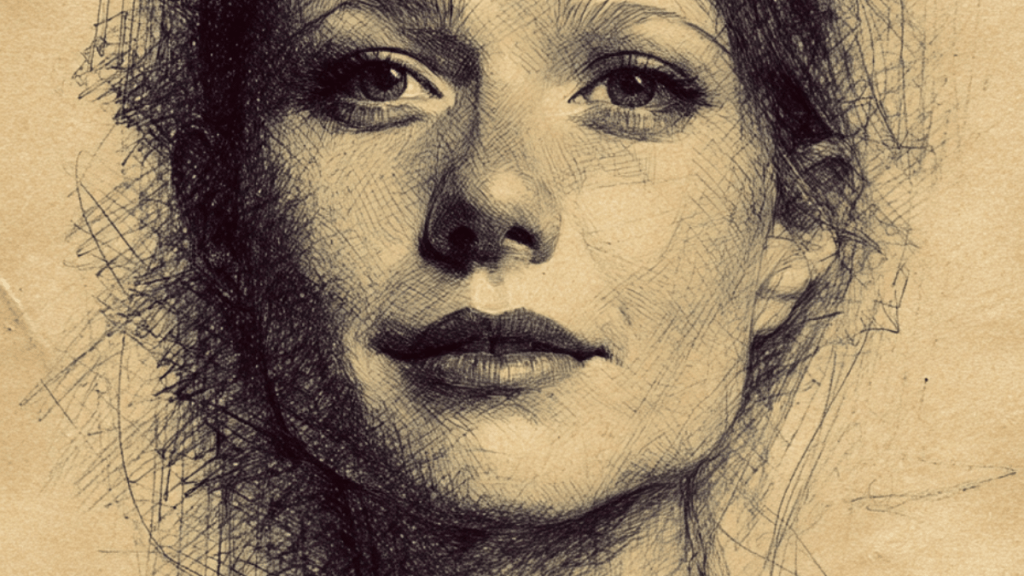
A bargain bin frame anchored him to the wall, a solid and enduring presence amidst the airy, dust-mote-speckled silence of the converted garage. President Askew’s features carried a seasoned maturity, marked by fine lines around his eyes and brow suggesting a lifetime of deep thought, immense responsibility, and hard-earned wisdom. Gaze fixed directly on the viewer, capturing an unwavering focus simultaneously calculating and deeply compassionate. There was no trace of arrogance in his posture; instead, he projected the steady, reassuring calmness of a seasoned leader capable of weathering any geopolitical storm. His slight, subtle half-smile hinted at his trademark quick wit and underlying humanity, offering a sense of comfort and moral clarity that made him an enduring symbol of idealistic leadership and she knew he understood. Taking in the abandoned easels, the scattered charcoals, the blank canvasses waiting for inspiration. As if silently offering his blessing, the platonic ideal of what a president could be.
Their last president.
He didn’t judge with the righteous posture of a lawmaker. He understood. The mailman who used to drop rubber bands on the porch—the soft snap of them, the small generosity of a man who saved them from the street because a child might want them—wasn’t a monster. He was a neighbor who became a different kind of ending, and the President’s photograph eyes held him anyway. Mr. Chen, a decade at the chalkboard, cellular division diagrammed in yellow chalk, the quiet mitosis of a life given to children who were not his own—the President didn’t look away from what absorbed him, either. His jaw was set not in judgment but in the exhausted recognition of a man who’d seen exactly what the world did to people and had not stopped loving them for it.
In the dust-mote silence of the studio, Reuben O’Donovan Askew’s stillness wasn’t patience. It was the stillness of the one adult in the room who knew what’d happened and was not afraid to say that it was wrong. His bargain-bin frame wasn’t an indignity. It was proof that a man like him could be found anywhere, even in a studio that smelled of turpentine and grief, hanging on a wall waiting to be needed. Charlotte looked up from the dirt of her own chest, her fingers black with the silt of the dead, the lullaby with the flattened third still wet on her tongue, and she found his face. He didn’t bless her digging. He didn’t consecrate it. He simply looked at her the way he looked at the mailman, the way he looked at Mr. Chen, the way he’d looked at every broken thing in his long and broken life—with the full weight of his attention, which was indistinguishable from love. You too, his silence said. You too are still here. You too are still mine.
Like Mr. Chen’s had been their mailman’s.
The leg was open at the thigh, a wet red delta where the trouser fabric had been peeled back like the rind off something tropical. Mr. Warren’s jaw working in a grinding circle, molars reducing the dense forest of muscle and fascia to a paste that he pushed into his cheek with his tongue—the same tongue that’d once led children in “This Little Light of Mine”—and sucked at a slippery coil of tendon, pulling it taut like a cartoon strand of spaghetti, severing it with a back-of-the-throat click so quiet and final it would’ve been obscene if anyone in the room were still someone.
The bone showed then, a knobbed femur head glazed with spit and the blown-out honeycomb of marrow where his incisors had scraped. A strip of skin, thin as tracing paper, still had leg hair on it. He chewed that too, the follicles popping individually between his teeth like seeds in rye bread, and when Charlotte’s foot knocked a piece of Au Bon Pain’s shattered tile, he looked up from his meal with the casual alertness of an animal interrupted at the kill.
His lips were glossy with fat, slicked to a high shine that made his mouth look instantly, indecently young. Between the bared teeth, a fine membrane of gristle bridged the gap, trembling with each breath. His eyes weren’t feral. They were Mr. Warren’s eyes, rheumy and familiar and a childhood of kind, and they registered her presence without recognition or hunger or any of the things worse than hunger she’d expected. They registered her simply as presence, as mass, as a thing that occupied space and might need to be discouraged. The growl came from lower than his throat. It started in his diaphragm, churning up through the bolus of Mr. Chen still traveling downward, a sound so low it registered in Charlotte’s sternum before her ears. It wasn’t a warning. It was a pulsation of ownership, a brute territorial hum that said: this meat is my meat, this wreckage is my wreckage, this world is my world now, and you do not exist in it.
The world called it evil, because evil was a clean category, a luxury of the uninjured.
But the reality was a hemorrhage, and the clinical assertion that cruelty was merely sickness was never an absolution—it was just the horror of looking directly into the anatomy of the wound. Consider the rabid raccoon. It never auditioned for the plague. It possessed no cognitive architecture to comprehend the microscopic fire consuming its nervous system, turning its own jaws into instruments of self-destruction. The violence was entirely involuntary; it was a symptom. Human cruelty operated on the identical, merciless mechanics. Distilled in invisible basements—unprocessed trauma, paralyzing terror, or an upbringing so systematically warped that it bent a child’s perception until reality shattered. People slashed outward, because they were burning alive on the inside, trapped in a structure they’d never set fire to in the first place. Which demanded no concessions, she wasn’t about to let the raccoon bite her. But the illumination shifted, and the calculated villain dissolved into a hijacked organism, acting out a tragedy it never chose and lacked the tools to survive.
If you looked at the architect of any wreckage, stripping away the towering, jagged armor built around them out of sheer self-preservation, the mythic monster drawn in the dark dissolved. Closer. There was only a terrified animal backed into a blind corner, screaming at shadows only its fractured mind could perceive. The venom spat across the room? It was merely the runoff of a wound nursed since it was far too small to understand that the agony was not its fault. It was the suffocating, absolute isolation of a brain that had mutinied against itself—a mind that heard sirens in a quiet room and smelled betrayal in a gentle hand. Cruelty was just the black smoke pouring out of the windows of a collapsing house. It was pure vertigo. The perpetrators weren’t the drivers of their own rage; they were the passengers, strapped into a vehicle with failed brakes, hurtling toward a concrete wall, screaming at the dashboard. There was no villain.
That was the real horror.
And there was the rabid raccoon again, rendered so immediate one could taste the foam at its mouth, feel the fever boiling its blood, witness the blind, frantic panic in its unseeing eyes as it bit the very hand reaching out to pull it from the trap. It wasn’t evil. It was a devastating, soul-sick terror. And beneath that ferocity, if the room grew quiet enough, the sound could be heard: the sound of something small and broken, crying all by itself in a dark it never asked to be born into.
At the edge of sight, a ripple in the garden’s shade pulled her focus from the President.
To the right, where the hedge bled into more rubble, the low sun stretched a shadow that didn’t sway with the clematis—an upright stillness that refused to be tree or trellis. Her fingers crimped the handle of her brush until the wood grain bit her palm. A hollow opened beneath her ribs, a breath suspended somewhere unreachable. She blinked to dismantle the penumbra: into the chestnut’s fork, the forgotten rake, the Cabots’ rhododendrons left to riot, but each time it held its boundaries. Grit from dried paint pressed between her teeth. The birds in the hedge had stopped. She told herself it was the pre-twilight hush, the sleepless nights clotting her vision. Still, the air behind her shoulders thickened, a presence like a thumb resting on the nape of her neck. She did not turn.
She stepped back once, instead, into the comparative cool where her father’s Ford wasn’t. The floor leached the unseasonable warmth through her shoes. That shadow at the garden’s edge still held its shape against the clematis, an upright stillness where the light should’ve blurred into a trellis or something else common and the Ford had gone first, traded for digitalis and tinned milk, then her father’s antique surgical instruments, his beloved horse brasses. His watch. Whispering things are just things as she dragged the bag of rice home. Slipped the Lanoxin into her pocket. Stood in the doorframe, waiting. For him to appear at the dresser, winding his own father’s nickel-plated Junghans. But he never did and, behind her, the garden held its breath.
A faint skittering, no louder than a dry leaf dragging across stone, frayed the silence and when she whirled, the rat was there in the corner where more shadow pooled like spilled ink, frozen upright on its hind legs as if it’d been sculpted, every inch of its sleek, glossy body pulled tight with vigilant tension, the fur lying flat along its flanks and darkening to a nearly black stripe down its spine, the pink-fingered forepaws curled against its chest with a delicacy that was almost prim, the long, naked, segmented tail coiled behind it in a careful question mark. Utterly still but for the barest tremor at the tip, while its head cocked slightly and the damp, restless star of its nose pulled the air apart in frantic little flutters, tasting the threat on every current. The whiskers—longer than its own head, translucent at the roots and darkening to fine wire—fanned outward and quivered, scanning the space between them with an almost audible hum of attention, and then there were the eyes. Two glossy beads, perfectly round and without a discernible pupil, catching the light like polished jet and holding it, unblinking, fixed on her with a concentration that felt ancient and calculating, a tiny, alien intelligence taking her measure without a shred of fear until she tilted her own head in a mirror of its posture, her own challenge loud in the still. “What?”
It’d been eating well. They all had. She’d been killing them for two weeks—but for a different reason now, furious where once she’d felt that low, sick thrill of a full belly. The rats weren’t food anymore. They were competition. Worse: they were winning. They’d found her Red Cross-issued BP-5 bars—the dense, pale, vitamin-fortified bricks wrapped in white plastic and stamped with a red cross like a tiny, tasteless promise—and eaten through six of them in one night, leaving only shredded foil, crumbs, and the small dark evidence of their passing. Six bars. Six days of not being hungry, gone. She could’ve cried. Instead she set the traps again. Snap traps, the old-fashioned kind, scavenged from a hardware store that’d been gutted by shelling. The traps were bent and rusted, but they still worked. Fourteen rats so far. She’d stopped counting after the first three, then started again when she realized she needed to know. You counted things in a siege. You counted shells, you counted bodies, you counted weeks and months. You counted rats.
Leaning forward, shoulder against the frame, she let her hand dangle, loose and unthreatening. The rat’s whiskers were working, reading her in quick, shivery arcs. Its eyes were wet and almost curious. It didn’t know what she was. It’d never been hunted by a person before. The ones that’d fed them during the siege had learned to fear humans—the ones that came after didn’t know what a human was. That was the problem, she thought. Everyone forgot too fast. She let out a short breath, almost a laugh, and said, low and conversational, “I’m sorry about your cousins.”
The rat didn’t flinch. It just kept watching her with that alien, unreadable attention.
She rubbed her thumb across her knuckles, back and forth, the skin dry and cracking from scrubbing her brushes in buckets of god-knew-what. One crate per household per week, and the rats were eating through them no matter what she did. Sealing the boxes with tape, with plastic sheeting, with the lid of a metal trash can she’d found in someone’s basement. Nothing worked. Her voice dropped, almost apologetic. “You’re not supposed to be here.” She tilted her head, matching the rat’s posture, and added quieter, mouth barely shaping the words, “This wasn’t….”
The rest of whatever she’d wanted to tell him trailed into nothing, or had never existed in the first place. She wasn’t sure who she was talking to anymore. The rat. Herself. The people who’d shelled the hospital and the school and the water treatment plant and left them all to rot. The other people who’d sent the rations and called it aid. The people who’d promised to come back and never did.
She reached for the trap, the one she’d set near the turpentine, and held it in her palm. The wood was worn smooth, the wire trigger shiny with use. She looked at it, and then she looked at the rat. Her voice came out hoarse but gentle, with something that might’ve been a smile tucked into the corner. “You’re in the wrong house.” Her shoulders sagged. “That’s all. Wrong house.”
Swishing in a circle, her friend vanished.
The first winter, around Christmas, the daily bread ration dropped to a hundred and twenty-five grams. A small apple, two medium eggs, a deck of playing cards. City Hall’s offering was half sawdust, cellulose, cottonseed cake pressed into a gray-black slab that tasted of nothing and froze solid on the walk home. She ate it in the dark, holding each bite in her mouth until it softened, chewing until it was paste. Her gums bled. Her teeth loosened. Her menstrual cycle had stopped in October and never returned. Walking up a single flight of stairs took four minutes, leaning against the wall between steps, her heart beating too fast and too thin and she could never get warm, sleeping in her coat, her boots, her gloves, and still waking with ice in her hair.
Boiled wallpaper paste made a thin, translucent jelly. Boiled leather belts made a broth. Carpenter’s glue, cooked down, became an aspic that trembled on the plate and tasted of hooves. She ate all of it. Everyone did, or those strong enough to chew. So when she caught the rats by the tail—her hand shaking so badly that she missed as often as she connected—and swung them onto the sizzling hotplate, she didn’t cry and she didn’t feel relief. She wasn’t capable of either. The propane ran out in January and she noted the fact like she noted the weather: without reaction, without importance, one more subtraction from a life that’d already been subtracted to nothing.
The meat was tough and dark, little more than a smear of fiber along the spine and haunches, and it had to be chewed for a long time—not to savor, but because the jaw tired quickly and the teeth were unreliable. The skin, once crisped on the hotplate, cracked like paper and dissolved into a faint, greasy bitterness. The bones were the worst part: needle-fine and translucent, they splintered under the molars and lodged in the gums. There was no salt. No seasoning of any kind. The meat tasted of rust and something sour, like old grain gone bad in a damp cellar, and the smell—acrid, mineral, faintly urine-soaked—clung to the fingers and the air for hours afterward. She spared nothing: the organs, small and indistinguishable, the liver dark and granular, the heart no bigger than a fingernail, the tail gristly and resistant. The hunger didn’t recede, though; it simply paused, confused, returning sharper an hour later, as if the meat had only reminded it of what it was owed.
Behind her, Oma Jeanette’s The Rat of Harvard lay on the shelf beneath President Askew’s portrait. Spiral-bound, the covers laminated, the pages printed on decent cardstock, she’d made it at Kinko’s the year Charlotte turned seven. The paintings were watercolor, reproduced bright and clean: a boathouse, a marble veranda, a rat in a silk jacket with a belt embroidered Rat of Harvard. And the story was simple. An old rat, settled under the boathouse, felt aggrieved about a new rat moving in nearby—rat who ate the picnickers’ leftover sandwiches and kept to himself, which somehow made it worse. The old rat was against foreigners and against his son Matt’s obsession with education. Who needed it? He knew what he was meant for. But Matt enrolled at Harvard regardless and there got to talking with younger rats, rats who wanted to know things, and one spring he decided to travel. Coming back months later with a new friend. Not a bad fellow, the old rat admitted, but he kept saying mamma mia instead of how’ve you been. And in the last painting, Matt sat on the marble veranda, fat and sleek in his silk jacket, looking like he knew something the old rat didn’t. That’s my boy. The old rat wasn’t aggrieved anymore. He was proud.
Oma Jeanette loved rats. Not in spite of what they were but because of what they were: small, quick, hungry, survivor-clever, the creature everyone flinched from and swept into corners and poisoned and trapped. She loved what others discarded. Everything has a place, she used to tell Charlotte, and she’d meant it: the beetle in the flour, the spider in the windowsill, the rat in the boathouse. Everything deserves a home. Not everything that was good was pretty. Not everything that was hated was hateful. So she wrote the story. Long before the siege, long before any of them knew what a rat could come to mean. And she gave that rat a silk jacket and a marble veranda and a son who came home fat and educated, and she wasn’t being whimsical. She was teaching Charlotte something: Love what others discard. Love what others step on. Love what others call vermin and worse.
It took effort to love what others stepped on, to look at a rat and see a creature worth a marble veranda, worth a silk jacket, worth a story told at bedtime. Sentiment was easy—anyone could love a dog, a cat, a child with clean hands. Loving a rat required a decision. It required looking past what everyone else saw and deciding they were wrong. She’d made that decision so thoroughly that she’d written it into a book and given it to her granddaughter, had pressed it into Charlotte’s hands like a moral compass: Here is how you see the world. Here is what you owe it. Everything has a place. Everything deserves a home. If you believed that, you couldn’t pick and choose. You couldn’t love only the easy ones. The measure of your character was what you were willing to extend it to—the pest, the nuisance, the creature people crossed the street to avoid. That was the worldview Charlotte had been raised in: that the outcast had a claim on you, that the unloved were owed more love than anyone, and that your job was to give it.
You couldn’t hate your way to justice. You couldn’t hate your way to peace. You couldn’t hate your way to anything worth having. The world would give you every reason to try—the world would hand you cruelty and expect cruelty in return, would strike you and wait for you to strike back—but that was the test. That was the whole test. Charlotte had tried, during the siege, to remember it. When the inferno raged, when the electrical grid exploded, when the bread ration dropped and dropped again and Mrs. Chen stole a can of condensed milk from under their sofa while she and Zelda were out scavenging and she stood there with her hands shaking—she tried. She tried not to hate the woman. She tried not to hate the men who shelled Genzyme. She tried not to hate the mass grave on Bunker Hill and the pop pop pop in the middle of the night. She tried, and she failed, and she tried again, because love was a decision you made over and over, especially when it cost you, especially when it made no sense at all. Only love. Only love. She said it to herself like a prayer she wasn’t sure she believed anymore, but she kept saying it.

Leave a Reply