The horn didn’t cut the silence so much as it shouldered it aside, the way a door found a shoulder when the person behind it had stopped bothering with the handle. It came from somewhere north, low and flat, a single long blast that set the one good pane in the window to trembling, a thin hum lingering after the note had died. The hum was the last clean thing in the room. Shivering in the glass like a nerve, and then it stopped, and the silence crept back. Thinner now, bruised at the edges, a held breath waiting to be let out and knowing it wouldn’t be.
Voices followed.
German, sharp as the heel of a boot, the clipped syllables of men who’d given the same orders so many times the words had worn smooth of meaning. Move. Now. You don’t matter. But it was the tone that did the work, the way a dog learned the shape of a raised hand without needing to know the word for strike. The voices carried up Massachusetts Avenue from the direction of Harvard Yard, past the sandbagged checkpoint where Garden Street fed into the Square, past the charred husk of the old trolley, past the Out of Town News kiosk with its plywood face and its silent, gutted clock.
The crowd parted. Not quickly, not with panic—panic was a luxury that required hope, a belief that somewhere else might be safer—but with the slow, practiced choreography of bodies that’d learned the steps by heart and danced them in their sleep. A woman pulled her child into the old Coop doorway, the child’s feet dragging two clean stripes in the dust that lay over the bricks like a second skin. Gray and fine, not the dust of neglect but the dust of pulverized things, concrete and glass and older, softer things that’d been ground down and sifted across the Square until the Square itself seemed to be turning slowly into powder. An old man pressed his spine to the wall beside the Greenhouse Café, his shoulder blades finding the familiar hollows they’d almost worn into the brick over weeks of getting out of the way. Face registering nothing as two boys slipped past, into the alley between him and the locked barbershop, hands already lifting, faces already smoothing into the blank, patient look of the long-occupied. Someone’s grandmother crouched behind the burned-out shell of a sedan in front of the bank, her bundle clutched to her chest, and went so still the dust began to settle on her shoulders, a fine gray pollen, as if the city were already laying claim to her body, already beginning the slow work of burial.
Stillness was a skill, learned in the long months after the cordon closed, when the trucks stopped coming and the planes overhead were always the wrong planes and the only thing that moved in the streets without permission moved once and then stopped moving forever. Stillness was a language, and it was the only language the occupiers understood, because it was the language of the already-dead, the already-surrendered, and they had no use for the already-dead. They wanted the quick.
They wanted the ones who still flinched.
And then the car came.
It turned onto Massachusetts Avenue, shouldering into view like a storm front that’d learned to travel on wheels, and the first thing that registered was the shine. A wet, black, mineral shine, a gloss that’d never known the patience of dust or the slow erosion of rust, a surface that seemed to shed the very light that touched it. A Mercedes-Benz G4, a six-wheeled staff car from another century, its body long and low and serpentine, the fenders great sweeping curves of black enamel that swallowed the afternoon light and gave nothing back. Six wheels, thick and black and faintly glossy, each one turning with a deliberation that bordered on contempt. Rolling over the debris as if the rubble itself had been laid down in tribute, a carpet of broken brick and shell casings and the occasional dark, soft thing in the gutter that no one looked at anymore.
The chassis rode high, clearing everything, indifferent as a lifted chin.
Chrome caught the light along the hood in a bright, polished line, curled around the headlamps, gathered itself in the grille in a great grinning mouth of silver teeth. It threw the sick glow from the window back into the street, a little traveling sun that moved at walking speed, and the dust motes in its path flared and vanished. On each front fender a flag hung limp in the still air, black Hakenkreuz on a field of red, the fabric so vivid against the ruins it seemed to vibrate, a color that had no business being here, a color that belonged on wet flesh, on fresh paint, on something that hadn’t yet begun to die. Somewhere, in the middle of the dying city, someone had washed them and pressed them and hung them with care, and that single act of maintenance, that ordinary devotion to an obscene symbol, was somehow worse than the car, worse than the guns, worse than the checkpoint, because it meant that someone, somewhere, was living a normal life in the middle of the end of the world, folding laundry and starching flags and going home to dinner while half of Cambridge lay dead in their beds.
The car was new. It’d probably left the factory floor in Leipzig six months ago, the steel still carrying the faint, sweet oil of the press, the leather stitched by hands that punched a clock and drew a Reichsmark wage. The design was 1930s—the long prow, the sweeping fenders, the running boards and the high, arrogant grille—but the design had been 1930s for sixty years, and it would be 1930s for sixty more, because the Reich had found its shape and declared it final. Not nostalgia, not revival, not some arch propagandist’s choice to dust off a newsreel and resurrect a ghost. Simply what cars looked like, what cars had always looked like and would always look like, an aesthetic that’d ceased to be an aesthetic and become simply the shape of the world. The tires were newly vulcanized, the treads deep and geometric, and the engine idled at a frequency that could be felt in the roots of the teeth, in the soles of the feet, in the hollow of the chest. The car moved through the square at the exact speed of a man who’d never been kept waiting, and the silence that preceded it and the silence that followed it were two different silences, the first a waiting and the second a remembering, and both of them tasted of metal.
The driver sat behind the tinted windshield in black uniform and peaked cap, his face reduced to the blank silver discs of his sunglasses, reflecting only the ruined Square, the sagging awnings, the tents in front of the church, the woman frozen half-crouched behind the dead car, her reflection tiny and sharp and upside-down. The man in the back seat was a suggestion of dark wool and silver braid, a posture that’d been born in a cradle and raised in a riding school and hardened in a thousand rooms where lesser men stood and waited to be addressed. He did not look left or right. He did not need to. The Square had already been seen, already been catalogued, already been dismissed, and the car carried him through it like a piece of bad weather, something to be endured and then forgotten.
Taillights flaring once, red and hooded, and then the ruins folded over it and it was gone, and the Square let out its breath in a long, slow leak of motion. The old man detached himself from the wall, his hand brushing the brick as if to reassure himself that it was still there, still solid, still his. The woman retrieved her child from the Coop’s recessed door, the two neat tracks in the dust already filling with the slow, unimpressed drift of new dust. The motes in the window resumed their slow fall, and the one good pane stopped humming, and the smell of gasoline hung in the air, a perfume no one in this city had worn in two years, a scent that meant movement, that meant power, that meant the wrong people were still here and still fed and still driving clean cars through the end of everything.
You cannot be cruel enough to make him leave.
She leaned forward, her dry lips unsticking, and the crack of “I’m—” scraped out, barely voiced, before her throat clamped shut around the rest. Her jaw hinged open a second time, the tip of her tongue braced against her lower teeth, but no air moved; the sound died in her larynx with a dull, private click. Her eyes, red-rimmed and filmed with old tears, flicked toward Alex, then dropped. In her lap, her right hand gathered a fistful of that stupid napkin and twisted it into a pale-knuckled knot, then released it with a snap, her fingers smoothing the wrinkles in hard, deliberate strokes that pressed the blood from her nail beds. She tried again—two syllables this time, her voice thin and frayed—but mid-vowel her chin lifted, her shoulders drew back a fraction, and the words stopped, tilting upward into an unfinished question she let hang in the air before her mouth shut with a soft, final press of lips. A breath wobbled out through her nose, and she sank back, the inhale that followed catching high in her chest behind something solid she would not let soften into sound.
“Alex,” she began again, “I’m—”
The door detonated inward, frame splintering at the strike plate, and before the first echo had finished its jagged trip across the ceiling, a wall of heat rolled through the room—not the gradual warmth of a draft but a dense, blast furnace pressure that smelled of dust and asphalt baked under a noon sun. The sound that followed was a staccato of hard soles on bare wood, each impact sharp and separate, four boots hitting the boards in a rhythm that didn’t hesitate, didn’t pause at the threshold. Zelda’s head whipped around mid-vowel, her sentence cut so abruptly that her mouth hung open, empty, a thin thread of spittle snapping between her parted lips.
She saw the helmets first—the unmistakable coal-scuttle flare sweeping back from the brow, the folded rim that shadowed everything above the jaw, drinking the room’s dim light and giving nothing back but a curved, warped reflection of her own frozen face. The larger of the two figures was already moving past her and Marta had only just begun to turn, one hand still reaching for the bar’s edge, when gloved fingers clamped around her upper arm. The gloves were thick, black leather, ridged across the knuckles, and they sank into the soft flesh of Marta’s bicep with a grip that dimpled the skin and bunched the sleeve of her blouse up toward her shoulder. The goon pivoted, planted a boot, and pulled, and Marta’s body left the stool as if gravity had simply released her—the wooden legs screeched backward across the floor, the stool itself tilting, wobbling, and crashing onto its side with a hollow, ringing clatter, and her feet, still in their worn house slippers, lifted clear of the ground and kicked once at the empty air before going still.
The overturned stool rolled in a half-circle, one leg knocking against the floorboards with each slow revolution. Marta’s feet pedaled above the ground now, her worn terrycloth slippers slicing through the hot, still air. A sound tore out of her, high and wet, and then her jaw clamped shut, teeth biting off the cry so it broke into a strangled grunt. Alex’s mouth stretched wide around a shout; the tendons in his neck rose, sharp and corded, and Zelda watched the hollow of his throat pulse with a roar that reached her as a muffled, faraway smear of non-noise, its consonants frayed, its vowels flattened. Her own ribs pulled inward on the inhale—a quick, sharp draw that scraped her throat raw—and the exhale followed unbidden, shallow and fast.
Inside her chest, her heart struck bone, each beat a blunt thud that reverberated up her spine and bloomed dark at the base of her skull. With every impact, her peripheral vision shrank, the room’s edges dimming to shadow. Alex lunged forward a step, his lips forming a word she could see but not hear: the purse of a p, the stretch of an a, the baring of teeth on a final consonant. Spittle flew from his lower lip; a vein coiled at his temple. But the thud behind her ears swallowed the syllables whole. Behind him, Marta’s flailing arm struck the bar’s edge, knocking a tin cup into a silent spin. It struck the floor beside the stool, and no sound rose from the impact.
Zelda didn’t see him enter. She felt it.
A change in the air pressure, a subtle shift in the light, as if the room itself flinched toward a new center of gravity. The stormtroopers’ boots stopped their restless shuffling. Leather creaked as their spines drew up, vertebrae stacking one by one, shoulders snapping back into alignment.
Marta’s arm went slack in the grip that held her.
He crossed the threshold without haste.
His boots met the floorboards with a sound too crisp, too contained—click—a pause long enough to hold a breath—click—and Zelda’s heart stuttered between each impact, her pulse scrambling to match a rhythm that was not hers. He walked like a razor slid across a whetstone: slow, even, each degree of forward motion promising a wound. The chaos that’d filled the room seconds before now hung suspended, cowed into corners, and he moved through it untouched, a black shape passing through a photograph of itself.
At the nearest table, he paused. His gaze, half-lidded and unhurried, drifted across the scarred oak surface, the abandoned tankards, the candle stub drowning in its own wax. He might’ve been a man considering a table at a café, weighing the merits of the view against the angle of the afternoon sun. His head tilted a fraction. A finger, gloved in black kid leather so fine it whispered against itself, extended and traced the rim of an empty glass, a slow, circular, almost indulgent motion. He watched the glass with a private, aesthetic pleasure, as if the smudged rim and the dregs of silt at the bottom were a painting he alone knew how to appreciate.
Then—a switch flipped. The performance of leisure stopped. His gloved hand withdrew from the glass, two fingers lifting together in a single, precise motion. His head straightened, the tilt reversing along the same unhurried axis. His gaze passed over Alex as if he were a chair, rested on the broken frame of the door, slid to Marta—still lifted, still silent, her slippers dangling—and his expression didn’t change. He absorbed the tableau with the placid, unblinking curiosity of a collector examining a pinned insect. The corner of his mouth moved. Not a smile. Nothing so generous. Just a faint, reflexive tightening, a glint of something narrow and satisfied, there and gone.
His uniform drank the light. Black so deep the seams disappeared into shadow. The silver piping at his collar caught a stray beam and glowed for an instant, cold as a filament in a lightbulb about to burn out. When he breathed, the fine wool stretched across his chest made no sound. The air around him smelled of leather, boot polish, and something sharper underneath—ozone, maybe, or the metallic tang before a lightning strike. He reached up and removed his cap. The movement was unhurried, each joint in his arm articulating in sequence. He tucked it beneath his elbow, and as the brim turned, the death’s head insignia caught the light: a flat, bone-white grin beneath hollowed sockets, its silver trim flickering like a wink meant only for her. The cap settled into the crook of his arm with a soft, final creak of leather. And then his eyes found her—not a glance, not a sweep of the room, but a direct, weighted settling, as though she were the only solid thing in a room full of ghosts.
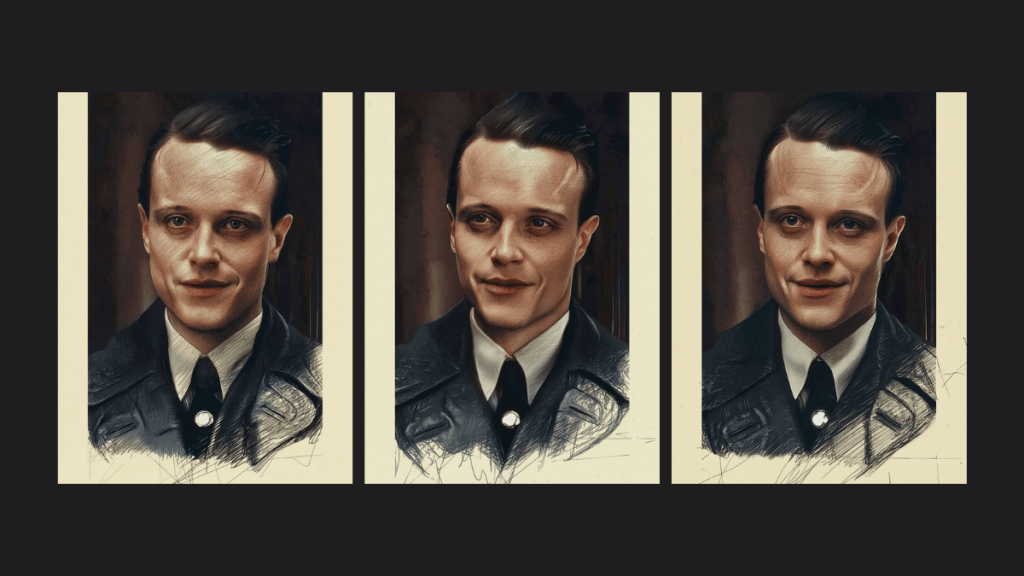
He had a face built for the terrible economy of an interrogation. In repose, it was almost delicate—the smooth, slicked-back discipline of his hair parting away from a forehead that was too wide, too pale, a blank wall of bureaucratic malice. His right hand rose to the breast of his tunic, the motion unhurried, each joint articulating in sequence—wrist, knuckle, fingertip—as though the air itself offered resistance worth savoring. Dipping inside the wool and emerging with a silver case, slim and unadorned, its surface so highly polished it threw a curved blade of lamplight across the opposite wall. He held it in his palm for a beat, his thumb resting on the catch with the intimate weight of long habit. A soft click, and the case opened along a hidden hinge, revealing a row of cigarettes nested in a groove of dark velvet, each one aligned with the next by a margin no wider than a hair.
He selected one with the care of a man plucking a single card from a fanned deck, drew it free without disturbing its neighbors, and tapped the filter once—twice—against the lid before closing the case with a quiet, final snap. Returning the silver to his breast pocket, smoothing the flap afterward, erasing the intrusion. Then he lifted the cigarette to his lips. They parted just enough to receive it, the dry paper catching for an instant on the lower lip before the weight of it settled into the cleft, and there it rested, unlit, canted slightly upward, a comma of pale white.
Held not like a vice, but like an instrument of measurement, waiting for the tension to reach its exact, lethal temperature before he struck the flint. The lighter’s flame caught the curve of a cheekbone that looked less like skin and more like shaved lard, cold and slightly translucent under the tavern’s low timber beams. He didn’t look like a man who enjoyed violence; he looked like a clerk who’d found an error in a ledger and was deeply, structurally offended by the messy math of it. The horsehide of his coat was thick enough to bury a heartbeat, a heavy, grease-polished thing that didn’t crease so much as it cracked, smelling of coal-smoke and the inside of an official sedan. Then came the smile, and the face forgot its own geometry.
It was the grin of a skull that’d suddenly remembered how to mimic a living man. The lips peeled back from his teeth with an oily, terrible compliance, a sudden, wet spasm of mock-colloquiality that didn’t reach the eyes. Those stayed flat, gray-blue and small, the color of stagnant puddle-water under a winter sky, tracking the micro-tremors of the room while his mouth performed the theater of a joke. The skin around his nostrils pinched into tight, marble parentheses, a physical reflex of disgust masquerading as laughter. It was an expression that didn’t invite you into the room; it locked the door behind you. A look that said I know what you are, and I am going to let you breathe for three more sentences just to watch you waste the air. A performance of safety that made the suspense feel instantly more dangerous than a raised rifle ever could. The teeth were too white, the laugh too loud for the smallness of his throat, a calculated rattle designed to fill the available space like gas. He leaned in, greatcoat groaning like a ship settling on its hull, and for that single, suspended second, the smile was a knife left on the table between them—bright, sharp, and entirely intentional.
The cigarette dropped away, and the unctuous theatricality of his smile vanished, leaving his mouth slightly compressed at the corners. The lips didn’t sneer; they simply tightened against his teeth, a subtle retraction that narrowed his mouth into a flat, defensive slot. It was the expression of a man tasting something faintly sour but refusing to spit it out. The slight indentation at the edges of his lips gave away the immense, coiled energy behind his silence—a physical tightening of the trap, his mouth utterly fixed, letting the silence stretch until the air in the tavern grew too thick to breathe.
Leaning forward onto the bar, the greatcoat exhaling a low, saddled creak as his weight settled onto his elbows. The sour compression of his mouth didn’t loosen; it fixed itself upon Marta with the patience of a vice left clamped to a workbench overnight, waiting for the wood to crack. Zelda, to his right, had ceased to register—a smudge at the edge of his periphery, the air where she stood cooling by several degrees. “Kaczynski.” The K struck hard against his soft palate, the -ynski compressed and dispatched with a faint, clipped finality, the way a man might spit out a bit of gristle discovered too late in a mouthful of good sausage. Then his own name followed. “Sturmbannführer August Voight.” Three heavy syllables rolled out with an easy, proprietary rhythm—bann drawn long, führer dropping into a soft, throaty rasp from the beer halls and parlors of Munich. “I am charmed.” He let the phrase hang. Then, quieter, with the ghost of a bow: “Wirtin.”
Marta’s chin lifted. The motion wasn’t deliberate so much as weighted, a rusted hinge forced past its stopping point. The stormtrooper’s hand still circled her arm, leather dimpling flesh, but she no longer acknowledged the grip. Her nostrils drew up and back, exposing the raw pink membrane inside. Her eyes, wet from the earlier struggle, had dried to a hard, glassy brightness. They passed over Voight’s face and stopped. “Der Drogensüchtige.”
Her lips stumbled on the German, the ü collapsing into a short, flat grunt, the ch catching in her throat where a Pole’s tongue had never learned to soften it. The word came out wrong—deliberately wrong, she’d spoken it often enough to know better—and the wrongness was the point. Then, in English, lower: “The drug addict.” The th hardened to a d, the a flattened and broadened, the phrase stripped of its Germanic polish and dropped on the bar between them.
Voight’s cigarette had stopped halfway to his lips. It stayed there, suspended between two fingers, a thin white hyphen in the gloom. He drew a breath through his nose and his chest rose beneath the black wool. Held it. Released it in a thin, controlled stream. His mouth didn’t tighten. His jaw didn’t clench. The only movement was the cigarette, rocking in a tiny, absent metronome between his fingers.
Then he brightened.
His brows lifted, his eyes snapped open, the whole face unlocking into an expression of sudden, violent pleasantness. As he straightened to his full height, the light caught his eyes at a new angle, and their true color surfaced: a gray so pale it verged on blue, the blue of skim milk in a tin cup, the blue of old ice on a roadside ditch, a color that’d forgotten whatever warmth it might once have held. His hand lifted from the bar, palm opening, fingers spreading, and came down flat with a crack that shivered through the wood and up into the glasses ranked behind. One of them rang—a small, bright chime that hung in the air and slowly died. “There we are.” The voice had climbed half an octave, warmed to a horrible, practiced conviviality. The smile that followed stretched wide and elastic, a skull’s grin pulled tight across living teeth, and those pale eyes stayed fixed on Marta with an amusement that did not blink.
He glanced down at the cigarette as though noticing it for the first time, turned it slowly between thumb and forefinger—one half-rotation, the paper rasping faintly against his glove—and then lifted it back to his mouth. His lower lip caught the filter again with that dry, papery brush, and his lips closed around it in a single soft motion, like the lid of a box settling onto its catch. The cigarette angled upward, canting just past her left shoulder, and his eyes—those pale, unblinking discs—never left her face. “My reputation precedes me. How wonderful.” His English was flawless, the grammar so exact it felt starched. “I am also Leiter Staatspolizeileitstelle Boston. Chief,” he added, flicking ash onto the floor. “You and I, it seems, are long overdue to make each other’s acquaintance.”
And it was the vowels.
A sudden, visceral lurch, like missing a step in the dark.
Throat constricting, folding inward, muscles drawing together of their own accord, sealing off the air before she could gasp. Voight drew his a’s like her father had, low and broad, the sound opening at the back of the throat. The r’s rolled soft against the upper palate, not the hard Bavarian trill of the mountain villages but something further south, Lindau, the lake, the boats. Her grandmother had sounded the same. Her grandmother who’d called her Schatz with that same soft roll, that same unhurried cadence, the words rocking gently like water against a dock.
But her father’s voice had carried a permanent rasp beneath those sounds, a roughened edge from a boyhood spent shouting over the clangor of his own father’s workshop, tempered later by years of keeping his voice low in operating theaters, in recovery wards, in the quiet consultations where a surgeon told a family what he could and could not save. The Lindau vowels, the soft r’s, they’d survived in his mouth, but they’d been worn down at the edges, rubbed raw by the life he’d come from and the life he’d carved out of it. This man’s voice had none of that rasp. The same sounds, the same shapes—but sanded smooth, the rough edges planed away and replaced with something polished, something cool and dry that’d never known a workshop floor, never bent over a broken body in the middle of the night. It was her father’s accent with the labor removed. Her grandmother’s accent starched and pressed and buttoned into a uniform. The voice of a man who’d never once had to raise it, because the world had always leaned in to listen.
She became aware of her hand against her mouth, a door she didn’t remember closing—slowly, and with the uneasy sense that some part of her had acted without permission. The knuckles had left a small damp print on her upper lip. She pulled the hand down. It shook, a tremor fine as a tuning fork struck once and left to vibrate against the quiet, and she shoved it under her thigh, her weight pressing it into the hard wood of the chair, trapping it there. Waiting.
Voight’s gaze drifted from Marta to the room at large. He took his time. His chin tracked left, paused, tracked right, marking each empty chair, each bare tabletop, the cold hearth black with old ash. His free hand rose and performed a slow, open-palmed rotation at the wrist—a host inviting a guest toward a seat that did not exist, a table that was not set, a meal that was not coming. The gesture hung in the air a moment longer than necessary before his hand returned to his side. “Such a crowd we have this afternoon.” His sentences arrived on a thin, controlled stream of air, each phrase measured to end before his lungs ran dry. The inhale between them was audible—a soft, dry sip of breath through slightly parted teeth. He returned his eyes to Marta and let them rest there, unblinking. “Yet you came out to greet us personally. I am touched.”
He placed the cigarette on the edge of the bar—gently, filter overhanging the wood by a finger’s width—and folded his hands in front of him, one palm cupped inside the other, the posture of a parish priest beginning a difficult but not unpleasant conversation.
“My men have been standing outside in the sun for the better part of an hour. I imagine they could use a drink. Something reviving in this heat.” He paused. His lower lip pushed forward a fraction, contemplative. “I understand you keep a well-stocked cellar. And”—the pale eyes flickered, a brief, bright movement—“you have already demonstrated your excellent grasp of my particular tastes.” He straightened his cuffs, first the left, then the right, tugging the starched tan linen a quarter-inch out of each sleeve, the fabric whispering against the wool of his tunic. “We will make do with beer. You are, after all, a hostess of some reputation. I would hate for my men to leave with an incomplete impression of your hospitality.” He smiled—the same stretched, unsteady smile—and his voice dropped to a murmur. “It would be rude to send them away thirsty.”
Marta planted her feet. The guard’s grip was still on her arm, the leather creaking whenever she breathed, but she no longer seemed to notice it. Something had shifted in her stance—a settling, a rooting, a boar dropping its weight onto its forelegs before it charged. The floorboards beneath her worn slippers seemed to belong to her again. Looking at Voight, now, like something that’d crawled out of the drain. “There is no beer.” Her voice scraped out of her throat, low and rough, enunciating each syllable. “There has been no beer since the rats put on uniforms and learned to speak.” She leaned forward, mouth inches from his. “Piss in a glass and drink that.”
He peered over the bar, as if looking for a hidden cask. “No beer. No schnapps. No Pervitin. I am beginning to think you do not like me, Frau Wirtin.” He hesitated. “Or perhaps you simply like your guests to suffer. I can respect that. We Germans have a certain fondness for suffering, as you’ve noticed.”
Turning her head to the side, Marta spit.
At first, nothing. The room had gone still, and Voight with it. But then Zelda saw it: a thin, rapid tremor in the muscle beneath his left eye, so small it could’ve been mistaken for trick of the light. It came and went, came and went. Then his jaw shifted, just off-center, grinding once, twice, before settling. He was still smiling, but the smile had grown too tight at the edges, the skin pulling white across his cheekbones. His nostrils flared on every third breath, like someone scenting something in the air that wasn’t there. A fine sheen of sweat glazed his upper lip, dampening the pale, hairless skin above his mouth, and he kept tucking his lower lip under his teeth, pressing down on it until the blood left, then letting it slide back out, wet and red. The pupils had eaten the gray-blue, leaving only a thin ring of cold around two black pits, and in the dim light they seemed to pulse, widening and narrowing in tiny, arrhythmic flutters, as if the eye itself couldn’t decide how much of the world to let in.
His fingers moved. Just the tips, brushing against one another, a ceaseless small rubbing—thumb against forefinger, forefinger against middle—restless in a way that had nothing to do with the conversation. The cigarette had gone from the bar to his hand to his mouth and back to the bar again, a nervous orbit he couldn’t finish. His breathing was wrong, too: a little too even, a little too deliberate, the inhale held a beat too long, the exhale measured out in two sharp puffs through his nose. It was the breathing of a man counting something. Tamping something down.
Pervitin, sure, if he ground it up and snorted it.
A waxwork with a pulse, his charm and his cuffs and his soft, patient, death’s-head smile. Her hands had locked around the edge of her chair, the wood biting into her knuckles, and she could feel her pulse hammering in her fingertips, in the thin skin of her wrists, throbbing inside her head. The betrayal cut so deep, because it wasn’t foreign. It wasn’t an invasion from outside. It was cancer that’d grown inside something she loved and here was its ambassador, grinding out a butt on the counter.
For a non-insane German, the Reich wasn’t just a political disaster. It was the systematic corruption of everything that made German identity meaningful. The language, the culture, the intellectual tradition, the domestic life, the religious heritage, the local particularity of places like Lindau—all of it was taken, hollowed out, and repurposed as machinery for murder. The same language her grandmother used to sing lullabies now issued orders for mass shootings. The same educational system that produced her father the surgeon also produced men who ran starvation blockades. The same precision and discipline and cultural pride that made Germany a civilization also made it a killing machine. That was the horror: not that Germany became evil, but that evil wore Germany’s face, spoke Germany’s language, used Germany’s virtues.
The feeling began at the base of her skull, a cold prickle that spread downward in a slow tide, vertebra by vertebra, until her whole spine was a column of ice. Her breath stuttered, catching on nothing, and for a moment she couldn’t swallow—the muscles in her throat just refused. Then the nausea came, sudden and greasy, rolling through her stomach. Her skin went tight and hot at the same time, a cold sweat blooming along her hairline, behind her ears, in the small of her back. The room tilted one degree to the left. Her inner ear rang, a high thin note that vibrated through her teeth and into her tongue, and she tasted metal, the tang of a nosebleed before the blood arrived.
At the edges of her vision, the room warped
So she sat in the chair and shook, silent and still, while the violation worked its way through her like a poison, like a radio signal meant only for her—tuned to the exact frequency of her father’s voice, her own voice, and beneath it all, the crackling static of a language she could no longer claim. And through the fog of it, one clear, cold thought surfaced, sharp as a splinter: this is what I am. The words didn’t form. Not in German. Not in English. Just burned, a white-hot coal somewhere deep inside, and she understood that she would never be clean again.
This was what it felt like to be raped.
Her hands unclenched. Not because the feeling had passed, but because the muscles had given out. They lay in her lap like dead birds, white and still. The silence in the room roared. And Zelda sat there, hollowed out, feeling the last of her childhood leave her body like a fever breaking in reverse. You killed everyone I love, you destroyed my city, and now you stand there with your soft hands and your clean uniform and you ask us for beer like we’re all old friends. You are nothing. You are less than nothing. You are a murderer wearing the skin of a man. And I will not serve you. I will never serve you. I would rather burn this place to the ground with both of us inside it than pour you a glass.
But Marta was the one talking, leaning forward even more, enough that the guard had to tighten his hold or risk losing her. She didn’t look at him. Her eyes stayed on Voight, two black points in a broad, exhausted face, and something behind them was burning low and steady, a fire that’d been banked for a very long time and was only now beginning to draw air. “Nie ma piwa.” The Polish dropped from her tongue like a gob of phlegm. She drew herself up. The guard’s hand was still on her arm, but she stood as though it wasn’t, her shoulders squaring, a broad woman with a ruined life and absolutely nothing left to lose. “Go back to whatever hole you crawled out of, Zbrodniarz, and tell the other cultists that the Green Dragon is closed.”
The smile was a cheap thing he’d rented; what lived underneath had never been far. It surfaced now, slow and total, as the fine muscles of his face gave up their borrowed work: the mouth flattening, the cheeks going hard, the skin around his left eye jumping with a rhythm of its own. Gazing down with the particular ease of entitlement—a man looking at something he already owned and had only to decide what to do with. The pupils had swallowed the pale gray-blue, now, leaving just a cold wet shine, and in that shine there was no fear, no anger, no heat at all. What crawled out from behind the mask was not the meth. It was the part of him that signed orders. The part had read lists without blinking. The part found the suffering of others as boring as weather. It filled the room like a gas, odorless and lethal, and when his hand closed around the cigarette, crushing it with a slow, considered pressure, the gesture had no violence in it. Only ownership. The same ownership that was in his eyes when he’d looked at her. The same ownership that said: I have killed better people than you. I will kill again. And there is nothing in this room that can stop me. It was the most human thing about him, that malice. The mask hadn’t hidden it. The mask had only made it wearable.
“Herr Smith.” The name dropped from his mouth. “Tell me where he is, or—”
Alex’s moment arrived with all the grace of a drunk stepping into wet cement. He made it to his feet and stood there, chest thrust out, shoulders back, the posture of a boy who’d practiced heroism in a mirror and never once considered how it might look from the front. His hands kept opening and closing at his sides, and there was a quiver in his thighs that he couldn’t stop no matter how hard he locked his knees. Zelda watched him glance at her once—quick, furtive, a man checking to see if his audience was watching—and then he turned to face Voight like a man sighting down a fence post.
“Leave her alone.” His voice came out louder than the room required, pushed from some deep, overfull place behind his diaphragm, and it broke on the second word before finding itself again. “Marta hasn’t done anything to you. She doesn’t know where Bill is. They’re separated—divorcing, all right? He doesn’t even come here anymore. So you can take your goons and go.”
Goons snagged in his throat and he swallowed hard, jaw tightening around the embarrassment. He crossed his arms over his chest, then uncrossed them, then let them hang, because he’d forgotten where men put their hands when they were being brave.
Voight’s head turned. The rest of him didn’t, one hip against the bar, the pose of a man interrupted mid-thought. He regarded Alex for a long, unbroken moment, the way a man regarded a goat that’d wandered into a church—not with anger but with a vast, almost bureaucratic disbelief. His mouth opened a quarter inch, closed again. For the length of a breath, no one spoke. And then Voight leaned back, just slightly, as if to get a better view of the whole absurd arrangement. When he finally spoke, the words came out low and even, scraped clean of anything so generous as anger. “And we are?”
Alex’s mouth opened on a word that had no shape. His Adam’s apple rode the full length of his throat and down again, a slow, visible swallow that caught the sun on its way past. He blinked—once, twice—and for the first time since the door had come apart, the heroic posture sagged, his shoulders forgetting their mirror practice and slumping toward something softer and younger and far less certain. “Alex. Alex Woods.” The name came out in two pieces, as if he were introducing two separate people who happened to share the same breath. He coughed, found a little scrap of defiance in the movement, and pinned it to his voice. “I’m a friend of the family.”
Voight absorbed this information without a change in expression. The silence that followed was a small, surgical thing, a pause calibrated to let the name deflate in the room’s quiet. Then, very slowly, his head tilted a quarter-inch to the left, and the corner of his mouth performed the smallest possible contraction—not a smile, but the muscle-memory of one, the ghost of an amusement that’d passed through this same face a hundred times before and left a faint, permanent groove in its wake. He uncrossed his ankles and took one step toward Alex, then another, the leather of his coat announcing each shift of weight in a low, patient creak. He stopped at a distance carefully chosen: close enough to be intimate, far enough to be insulting, the distance at which a man might examine a stain on a tablecloth and decide whether to send it back to the laundry or throw it out entirely.
“A friend,” he repeated. The word rolled around in his mouth like a boiled sweet he’d discovered too late was not to his taste. He let his gaze track from Alex’s unpolished shoes up the length of his rumpled trousers, pausing at the cheap belt, the frayed collar, the chin that hadn’t been shaved that morning, holding Alex’s gaze. Herr Smith. Tell me. How many friends do you imagine this family has left?” He didn’t wait for an answer. His right hand rose, palm out, fingers relaxed, and gestured toward the empty tavern as if presenting evidence to a courtroom only he could see. “The room is empty. The street outside is empty. The whole city has learned to walk on the other side of the road when it passes this door. And yet here you are. Alone. Unarmed.” His hand dropped. “Either you are very brave, or very stupid, or you have something valuable to offer me. Which is it?”
Alex’s jaw tightened. A muscle in his throat bulged and disappeared. The quiver in his thighs had traveled upward, and Zelda could see it now in the trembling of his left hand, which he pressed flat against his trouser leg as if to iron it still. “I don’t have anything to offer you.” His voice scraped out of him, hoarse and thin, but it held. “I’m just telling you the truth. She doesn’t know where Bill is. No one does. He left months ago. You’re wasting your time.”
Voight considered this. His lips pursed, relaxed, pursed again. Then he reached out—a slow, almost gentle motion—and took hold of Alex’s chin between his thumb and forefinger. The black kid leather creased against the stubble. He turned Alex’s face to the left, then to the right, as if inspecting the teeth of a horse he was not yet sure he wanted to buy. Alex’s whole body went rigid, a statue of a man trying not to flinch, and Zelda watched his fingers curl into fists at his sides and stay there, useless, because what was he going to do, hit a Sturmbannführer while two stormtroopers stood not ten feet away with truncheons on their belts and no reason in the world not to use them?
“You are trembling,” Voight observed. There was no malice in the statement. It was clinical, dispassionate, the tone of a doctor noting a patient’s pulse before deciding on a treatment. “That is good. Trembling means you understand the situation. Trembling means you are not so stupid after all.” He released Alex’s chin with a small, dismissive push, and Alex stumbled back a half-step before catching himself against the edge of a table. Voight was already turning away, the motion smooth and unhurried, his attention drifting back toward Marta like a searchlight returning to its designated sweep. “Sit down, Herr Woods,” he said over his shoulder. “You are not the man in this room you believe yourself to be, and I am tired of looking at you.”
The stormtrooper holding Marta shifted his weight, floorboards creaking. Which seemed to remind Voight of something, because he paused mid-stride, one foot still raised, lowering it with a small, decisive click. Addressing the stormtrooper without turning his head. “Release her.” A beat. “She’s not going anywhere. Are you, Frau Wirtin? Where would you go?” He gestured at the taproom, the broken door, the street beyond where the afternoon sun was bleaching the cobblestones to bone-white. “This is your home, after all. Your kingdom. And we are your guests.” That non-smile of his deepened. “A good hostess does not abandon her guests.”
The trooper’s hand loosened, finger by finger, and Marta’s arm dropped to her side. Lifting the other moment later and rubbing the place where the leather had dimpled her flesh, a slow, absent, almost maternal motion, as if soothing a child who’d fallen and scraped a knee. Her eyes held Voight’s, and in them there was no gratitude, no relief, only the dull, banked fire of a hatred that’d stopped being an emotion and become a structural part of her, like bone, like breath. She didn’t sit. She didn’t move. She just stood there, rubbing out the ache, watching him.
And Voight, for the first time since he’d materialized and ruined their lives, looked almost pleased. Not happy, of course. Not warm. But settled, a cat flopped into a sunbeam, satisfied that the mouse in the corner was not going to try anything unexpected. He drew a fresh cigarette from the silver case, the ritual repeated with the same liturgical precision: tap, tap, settle. The flame from his lighter leapt up and caught the tip, flaring red before settling into a steady, creeping ember. He drew on it, held the smoke in his lungs, and let it out in a thin, grey plume that rose toward the low beams and vanished.
“Now.” Vapor curled around the word, softening its edges. “We will try again. Where is Bill Smith?”
“I don’t know anything.” Her voice was pure cardboard, how a woman might tell a salesman she wasn’t interested. Again. “There’s no one else here, either, including that rat bastard.”
Voight inhaled again. “Let us not waste each other’s time with this nonsense.” Smooth, almost conversational, a man suggesting a reasonable compromise over a business lunch. “I will tell you what I know. Then you will tell me what you know. Doesn’t that sound much better?”
Marta uncrossed her arms. The motion was slow, deliberate, a woman settling in for a long negotiation. “You must know, then, that I haven’t seen my husband—soon to be ex-husband—in three months.” She let her gaze travel from Voight’s polished boots to the death’s-head insignia on his cap and back down again, taking her time, spending his dignity in small coins. “So either you aren’t as well-informed as you think, Sturmbannführer, or you’re here for something else. Which is it?”
Voight watched her without interrupting. The cigarette burned down a millimeter. Ash gathered at the tip, held, held, and then he tapped it—one clean motion—onto the floor. “You don’t know anything,” he repeated, and the repetition was not agreement. It was a collector turning over a piece he’d been told was genuine, testing its weight against his palm. He let the silence stretch until Marta’s breathing had gone shallow and audible, a damp rasp in the back of her throat. Then he looked down.
Not at Marta. At the floor.
His gaze tracked across the boards with a slow, proprietary interest, moving from the base of the bar to the far wall and back again, marking the grain of the wood, the nail heads, the faint scuff marks where tables had been dragged. He took a step. Then another. The boards groaned under his weight—a low, confessional sound—and on the third step the groan changed pitch, deepened, became something hollow. He stopped. His heel came down once, twice, a soft, testing percussion, and the echo that answered was too deep for a room this size, too open, a pocket of air where air should not have been. “There is a basement here.” Feigned surprise, fading into satisfaction. “A basement where Herr Smith keeps a printing press. He uses it to produce materials that are, shall we say, unkind to the Reich. Pamphlets. Leaflets. Little seeds of discontent scattered across our tidy garden.” He lifted his eyes from the floor and found Marta again, and the expression on his face was not accusatory. It was worse. It was interested. A surgeon’s dispassionate appraisal of a tumor he was about to remove, weighing its dimensions, planning its cuts. “I know this.”
Softer as he continued, almost gentle, the same voice he might use to soothe a frightened child. “And I know more. I know the make of the press. I know the hours your husband prefers to work. I know which of your neighbors receive the pamphlets and which of them burn them and which of them come to us with their hands shaking and their consciences conveniently clean.” He paused. Took another pull from his cigarette. The tip flared orange and reflected in his eyes, two small fires burning in the pale grey. “You see, Frau Wirtin, I am not here to ask questions. I am here to confirm answers. The only variable I have not yet resolved is where your husband is now.”
“Enough!” Zelda shouted. It tore out of her—not a word, not a choice, but a word-shaped grief that’d been building since the start of the siege. Her chair scraped back as she stood, and she didn’t remember deciding to stand and she didn’t care. Her hands were trembling. Her whole body was trembling, an inner tuning fork struck somewhere deep in her chest that radiated outward until her fingertips buzzed. The rage that’d been eating her from the inside, the swallowed glass, the cold fire—it all crested at once and found a voice she hadn’t known she had.
“You come in here.” Her voice broke like waves on the beach and kept going, louder, shredding at the edges. “You break down her door. You put your hands on her. You threaten her. And for what? She told you. She doesn’t know where he is. She hasn’t seen him in months. But you don’t care, do you? It was never about Bill. It was never about the press. You just wanted someone to hurt.” Her lungs burned. She dragged in a breath and it scoured her throat raw on the way down. She didn’t look at Marta. She couldn’t or she’d lose it, the hot wire of fury that was holding her upright.
Voight stopped mid-syllable. His mouth remained open for half a beat longer than necessary, the unfinished word hanging in the air like a piece of fruit he’d been about to bite and thought better of. Then his lips closed. His head turned—not fast, not slow, but with the exact, economical motion of a camera lens rotating into focus. That gaze fastened on hers. The silence stretched. Voight didn’t move toward her, not at first. He simply stood there, one hand still holding the cigarette, the other resting at his side, and studied her with the detached, clinical interest of a man who’d just discovered a new variable in an equation he’d thought was solved. His head tilted again, a quarter-inch to the right. The corner of his mouth twitched—still not smiling, but closer. The preliminary sketch of a smile, waiting to see if the final drawing would be worth the ink.
Then he pivoted, turn uncoiling from his spine, a single fluid motion, and the steel heels of his boots struck the scarred floorboards in a deliberate pattern. Click. A pause that pressed against her eardrums. Click. A pause that swallowed the air between them. Click. He stopped close. Too close. The kind of close that had nothing to do with intimacy and everything to do with the erasure of it, a deliberate trespass on the small geometry of her body.
Her eyes came level with his chest. Black filled her field of vision, seams disappearing into nothing, the fabric so dark it seemed to drink the light before it could touch her. The silver piping at his collar glinted at the upper edge of her sight. And now she could smell him—bergamot and cedarwood, the clean, astringent brightness of something expensive clinging to expensive tailoring. Beneath it, birch tar and castoreum, musk and moss, a darker current running under the brightness. Amber. Vanilla. The scent curled into her nostrils and sat there, thick and foreign. She fixed on his tie pin, a single bright point in the drowning dark. Enameled Hakenkreuz, black on a white field, circular, silver at the edges. She stared at it because that was easier than lifting her gaze to whatever waited above.
“The publican,” he murmured, “seems immune to my charms.” His voice had dropped into something low and warm, a purr that vibrated in the air between his chest and her face. The cigarette fell from his fingers. It tumbled end over end, ember tracing its own small arc, and his boot came down on it with a soft, grinding pressure—once, twice—until the glow was gone. “You, however….” The corner of his mouth quirked. The words arrived on a breath of bourbon. “You are not.”
She faced him at last, the tilt of her head a gauntlet thrown. Her eyes found his and pinned them with the deadpan, bright insolence of a woman who’d heard charm of this particular register before and found it wanting. A smirk settled at the corner of her own mouth before she spoke, a deliberate, unhurried thing. “Oh, I know.” Matching his tone. “Marta’s only attracted to men.”
The blow came without warning—not a movement she tracked but a force that arrived already complete, a flat, hard obliteration of the space where her face had been. Her head snapped to the side before the sound of it reached her, a crack she felt in the roots of her teeth, a deep, jarring note that travelled backward into her skull. Pain lit up the hinge of her jaw, bright and immediate, a signal so total she couldn’t locate its edges. Hot pressure bloomed outward, blowing the side of her face into something swollen and foreign, a mask of itself. Her ear rang, a high thin whine that cut through everything else. Blood, sharp and metallic, flooded the pocket of her mouth before she even knew she’d bitten down—her tongue found the wet, ragged place inside her cheek where her molars had punched through flesh, the tissue already puffing, already tender.
Her knees gave. Not a decision, just the sudden absence of verticality. She was on the floor before she understood she was falling, her hip catching the boards first with a blunt, deep shock that sent a bright crack up through the socket and into her lower spine. Her shoulder hit next, a duller impact, then the side of her skull glanced off the wood with a secondary thud that rattled her vision—white sparks, brief, across the dark. The world tilted and settled wrong. For a long moment the floor was the only solid thing, its cold bleeding up through her palms, the grain of the wood pressing into the heel of her hand. Her jaw throbbed in time with her pulse, each beat a fresh, small detonation of heat that crept up toward her temple and down into her throat. The torn place inside her cheek kept welling, blood and saliva mixing into something warm and thin, and she had to swallow or let it spill. Swallowing hurt. The ring in her ear was fading now, replaced by a muffled, underwater thickness on the struck side. She breathed through her nose and felt the bones of her face protest, a dull, deep ache settling into the architecture of her skull. Nothing was where it’d been a moment ago. She was still on the floor. The floor was cold. The room kept happening.
She dragged in a breath that scraped all the way down and pushed herself up onto one elbow. The floor wanted her to stay down—her hip still singing its bright note of protest, her skull still humming from the secondary crack against the boards. Blood had pooled in the hollow of her cheek, warm and thickening, and she had to work her tongue around it, had to swallow before she could shape the words. Spitting the blood out, landing between them, bright on the ancient oak. Holding his gaze as the world spun around them. “I guess we’re in agreement, then.”
He watched her lips shape the words around the swelling that was already closing one side of her mouth. A muscle flickered along his jaw—once, small. He didn’t speak. The silence stretched. She watched him work through the line, watched it sink past the bourbon and the confidence, watched his eyes change as he found the hook. His fingers, still curled from the blow, loosened at his side. Then stilled. His lips pressed together, the lower one curving downward just slightly—a fractional collapse of the composure he’d been holding. Then it was gone, swallowed back into the hard lines of his face. He opened his mouth, as though to speak, and—
“Bastard!” The shout cut across the room, raw and splintering—Alex’s voice, ragged at the edges, the word already a weapon before his body followed it. He lunged forward, all linebacker and no calculation, closing the distance with the blind momentum of rage.
The goon intercepted him mid-stride. Not a struggle—an arrest. One hand closed around the back of Alex’s collar, the fabric bunching tight against his throat. The other found his shoulder and wrenched him sideways with a force that turned his forward charge into a violent, graceless pivot. His feet tangled beneath him, one ankle catching the other, and then the floor was rising up to meet him with the full weight of his own body behind it. His knees hit first—a crack that went through the wood and up through his bones, sharp and sickening. Then his palms, skidding, the skin peeling back against the grain. Then his chest, the breath driven out of him in a single percussive grunt. The side of his face pressed into the floorboards, the cold wood against his cheekbone, the grain rough and sudden. The goon’s boot settled between his shoulder blades—not hard enough to injure, just hard enough to remind. Hard enough to hold. Alex tried to lift his head and couldn’t. His breath came in wet, ragged pulls, his throat still burning from the collar, his knees still screaming, the floor still pressed against the side of his face. Somewhere above him, someone shrieked.
The goon hauled Alex up by the collar—fabric biting into his throat, the world swinging wildly as his feet scrambled for purchase and found none. Alex’s fist came up anyway, a blind, graceless swing, no weight behind it, just the dumb momentum of instinct. The soldier caught his wrist mid-arc and held it, fingers closing around the bone with the casual, grinding pressure of a man who’d done this before and would do it again. He didn’t laugh. He watched Alex’s face, watched the rage curdle into something weaker, and then he drove his knee up into Alex’s stomach. The impact was a short, wet, percussive thing—a sound like a fist hitting a side of beef—and Alex folded around it, all the air leaving him at once, a single choked syllable punched out of his throat. His hands flew to his gut, protecting what was already hurt. The soldier let him hang there for half a beat, bent and gasping, and then shoved him backward with a flat palm to the sternum. Alex’s body hit the floorboards beside Zelda. Juddering, a tectonic shift she felt through her own hip, her own shoulder, the point of her elbow still pressed to the wood. She tasted blood again—her own, still leaking from the torn place in her cheek—and her jaw gave a dull, sympathetic throb.
The second soldier stepped forward with the flat, heavy sound of leather and nail, each step a small, distinct report. He looked down at Alex—sprawled, wheezing, one hand still pressed to his ribs—and shrugged. “Was glaubt so einer eigentlich, was das wird?” (What does somebody like this actually think is going to happen here?) His voice was pleasant, almost conversational, the way a man might speak while watching an animal do something stupid in a trap.
The first soldier still held his grin, but it’d tightened at the corners, turned harder. “Guck mal. Die kleine Ratte zeigt endlich, was sie hat.” Look at that. The little rat finally shows what she’s got. He let the feminine Ratte land where it would—sie, she, a casual emasculation delivered with the same offhand precision as the knee to the stomach. Then his gaze slid sideways to Zelda, still on the floor, still bleeding from the mouth, and the grin loosened into something wetter. He looked at her like a man looked at a meal he hadn’t ordered yet but intended to. “Und du.” He let the du hang. “Wenn der Sturmbannführer mit dir fertig ist….” He didn’t finish. Instead he made a small, obscene gesture with his fingers, two of them pressing into his opposite palm, a single short motion, then looked at the second soldier and clicked his tongue. “Abfall gibt’s immer.”
There’s always leftovers.
He probed her thigh with his boot. “…Was meinst du, Fickstück? Wird der Sturmbannführer teilen?” What do you think, fuck-piece? Will the Sturmbannführer share?
The second soldier glanced at him.
“Die versteht sowieso nichts.” She doesn’t understand anyway. He crouched, bringing his face level with hers, close enough that she could smell the cheap tobacco on his breath, the sour note of unwashed wool. “Aber du wirst schon sehen, was mit so einer passiert, wenn die Herrschaften fertig sind.” But you’ll see soon enough, what happens to one of these when the gentlemen are finished. He held her gaze, then very slowly, very deliberately, spat onto the floor beside her.
Alex groaned and pushed up onto one elbow, his movements slow, gluey, his head still hanging. The second soldier stepped in close, reversed his rifle in a single fluid motion, and brought the stock down onto the back of Alex’s skull—a flat, hard, splitting note, wood on bone, a sound that seemed to fill the whole tavern and then keep going, ringing off the walls, ringing in her ears, a sound she felt in the hinge of her own jaw, in the bones behind her face. Blood hit the floorboards in a loose, wet spray, a pattern that reached across the wood in a long bright spatter and kept going until it found her. It struck her shin, her calf, warm flecks, startlingly warm, dots of heat against her skin that cooled almost instantly in the open air. She bit down, hard, on the inside of her already torn cheek—the fresh pain a bright, immediate flare that kept the gasp locked behind her teeth. The taste of copper flooded her mouth again, fresh blood over old.
Alex didn’t make a sound. His elbow folded and he went down, a collapse without transition, the body giving up its architecture all at once. His head struck the floorboards with a secondary, softer knock. One leg twitched—a single, aimless spasm—and then he was still. The soldier looked down at him for a long moment. Then nudged him in the ribs with the toe of his boot. Alex moved—a limp, involuntary shift, the body still answering to stimuli the brain couldn’t process. A low sound escaped him, not quite a groan, something further down. “Ach,” the soldier grunted, with some surprise. “Verteidigt er ihre Ehre.” Oh. He’s defending her honor.
He looked up at Zelda again, and something in his face rearranged itself. The contempt didn’t leave—it found new focus, sharpened, grew teeth. His eyes moved over her slowly, starting at her ankles and working up, lingering at the blood spatter on her calves, at the hem of her skirt where it’d ridden up when she fell. He took his time with each inch. His mouth loosened, the lower lip going wet and full, and his tongue touched the corner of it, a small, idle motion, the way a man might wet his lips before a steak he’d been waiting for. His gaze reached her face and stopped there, and he let her see what was in it. The room had gotten smaller. It was just the two of them now, and the body on the floor between them was no longer anyone who mattered. He smiled.
The smile was slow and private and carried no warmth at all.
Across the room, Voight winced.
It was a small thing, there and gone—a tightening around the eyes, a brief, involuntary recoil, the body answering a stimulus the will couldn’t override. His hand moved halfway to his temple and stopped, hovering, the fingers slightly curled, as though he’d caught himself reaching for something he’d meant to keep hidden. The crack of the rifle stock was still hanging in the air, a sharp lingering presence, and she understood, without understanding, that it was the sound that had done this to him. Not the violence. The noise. He blinked once, hard, and something moved behind his eyes—pain, bright and immediate, the kind that had a location and a texture—and then he swallowed it.
Then his face smoothed over. The hand dropped.
He looked at the two soldiers, and the look was not the look of a superior officer disappointed in his men. It was colder than that. It was anger with a target. “Genug.”
The word was clipped, final. He didn’t shout it. He didn’t need to. The two soldiers turned, and whatever they saw in his face stopped them cold. Voight’s jaw was set, the muscle at the hinge still flickering from the pain he’d pushed down, and his eyes were clear in a way that had nothing to do with sobriety. He looked at Alex on the floor. He looked at the blood on Zelda’s legs. He looked at the soldier who’d driven the rifle stock down and held the look until the man’s grin slackened and dissolved. No how dare you touch her. No she’s mine. Whatever was wrong with this man, it wasn’t what she’d assumed, and it wasn’t what these two had assumed, either.
The bar was on the floor, and he’d just tripped over it without noticing.
He touched his temple once—a brief, private pressure, the pads of two fingers against the bone—and then dropped his hand. “Raus.” Out.
AUTHOR’S NOTE: In Polish, the word zbrodniarz carries a deeply severe connotation that goes far beyond a petty thief or ordinary lawbreaker. It’s most accurately used to describe someone who commits heinous, large-scale atrocities, essentially translating to a war criminal, mass murderer, or perpetrator of genocide. While a standard offender is called a przestępca, reserving the term zbrodniarz for someone implies they’ve committed a zbrodnia—a grave crime against humanity, peace, or human life.

Leave a Reply