The illusion of invulnerability died at 4:15 in the morning, not with a declaration of war but with the shriek of descending flares and the thunder of naval guns that’d crossed twelve thousand miles of ocean to deliver their payload onto American sand. For fifty-five years, the United States had believed in its oceans. The Atlantic and the Pacific were not merely bodies of water in the American imagination; they were theological barriers, moats ordained by geography and reinforced by the Borah Doctrine’s relentless coastal patrols. The outer world—the Greater Germanic Reich that stretched from the English Channel to the Urals, the Japanese Pacific Accord that dominated East Asia and the Western Pacific, the various fascist satellites and client states that filled the spaces between—existed as an abstraction to most Americans. It was newsreel footage, State Department warnings, the occasional intercepted broadcast from a resistance transmitter that’d somehow survived the decades of purges. It wasn’t real. It couldn’t touch them.
The fortress was absolute.
The fortress was also, as it turned out, a paper-thin membrane stretched across a hollow shell. Five decades of isolationism had preserved American blood but withered American vigilance. The military, starved of foreign intelligence and collaborative training, had become a garrison force designed to patrol borders and intercept smuggler vessels, not to repel a coordinated, multi-axis invasion by the most sophisticated war machine in human history. The coastal defenses that lined the California shore were artifacts of the Great War, updated sporadically, manned by troops who’d never seen combat and who operated under the quiet, institutional assumption that the oceans would do their fighting for them. At 4:15 a.m., that assumption was incinerated.
The airborne assault came first, and it was a thing of terrible beauty. The Fallschirmjäger of the Greater Germanic Reich had spent decades refining the art of vertical envelopment, from the drops on Crete and Malta in the 1940s to the crushing airborne operations that’d secured the Caucasian oil fields and the Siberian frontier. The troops who descended into the San Pedro hills in the pre-dawn darkness were the inheritors of that lineage—specialized, battle-hardened, equipped with night-vision optics and lightweight automatic weapons and the quiet, professional lethality of soldiers who’d trained their entire careers for this single mission. Their transport aircraft, massive six-engine machines that’d crossed the Pacific in staggered waves from forward bases in Japan and the occupied Philippines, flew below the radar coverage that the American coastal defenses had relied upon since the embargo years. By the time the first parachutes bloomed in the darkness above the hills, the sabotage teams were already cutting the rail lines, already placing their charges on the power substations, already severing the communication cables that connected the West Coast to the national command structure.
The lights went out across Los Angeles County at 4:22 a.m. Not in a cascade, not in a wave, but in a single synchronized blink that plunged twelve million people into darkness. The highways that should’ve been evacuation arteries became parking lots of stalled vehicles, their occupants staring at the blackened traffic signals with the particular bewilderment of civilians who’d never imagined that the war could find them. The telephones went silent. The radio stations, those that still had backup power, began broadcasting confused, fragmentary reports that alternated between official denials and panicked eyewitness accounts. Something was happening. Something that the emergency broadcast system, designed for earthquakes and civil disturbances, had no vocabulary to describe.
Then the naval bombardment began, and the vocabulary of catastrophe expanded instantly into the realm of the apocalyptic.
The armada that’d assembled in the Pacific over the preceding weeks was the largest concentration of naval power in human history. The Kriegsmarine, rebuilt and expanded across four decades of unchallenged shipbuilding, had deployed its most modern surface combatants—battlecruisers, guided-missile destroyers, amphibious assault ships that carried not merely troops but the accumulated doctrinal knowledge of uninterrupted military evolution. The transports were escorted by aircraft carriers whose decks were crowded with ground-attack aircraft and fighters that would, within hours, establish air superiority over the entire Southern California theater. And beyond the German formation, serving as the outer ring of the invasion fleet, the Imperial Japanese Navy patrolled with the cold competence of a power that’d dominated the Pacific since forever.
The bombardment began at 4:30 a.m. precisely, the German obsession with timetables manifesting in the synchronized destruction of every identified coastal defense position between Santa Monica and Huntington Beach. The naval guns weren’t the weapons of the previous war; they were precision-guided, satellite-targeted, firing shells that could be corrected in mid-flight and that struck with an accuracy that seemed to the defenders like the hand of an angry god. The coastal artillery batteries that’d stood for half a century, their guns trained perpetually on an empty horizon that’d never produced an enemy, were obliterated before they could fire a single round in response. The naval air stations at North Island and Point Mugu were cratered by cruise missiles that arrived without warning, launched from submarines that’d penetrated the coastal security zone weeks earlier and had been waiting, silent and patient, for this moment.
The landing craft hit the beaches at dawn.
Long Beach, that sprawling industrial port city that’d once symbolized American maritime commerce before the embargo had withered it to a regional shadow, became the primary lodgment. The German shock divisions that stormed ashore were not the Wehrmacht of the 1940s, not the army of horses and bolt-action rifles that’d conquered Europe. They were a modern mechanized force, their landing craft disgorging armored personnel carriers and main battle tanks directly onto the sand, their combat engineers deploying prefabricated causeways that allowed the second and third waves to flow ashore in an uninterrupted torrent of steel and disciplined aggression. The defenders—a mix of National Guard units, Coast Guard station personnel, and the peacetime garrison of a nation that had not fought a major war in living memory—were overwhelmed in the first hour. Those who survived the initial bombardment found themselves facing an enemy that seemed to move with the fluid, coordinated precision of a force that’d done this before, many times, on many hostile shores.
San Pedro fell by noon. The port facilities, captured largely intact, began receiving the heavy transport vessels that carried the armored divisions, the artillery parks, the fuel reserves, and the million tons of supplies that the beachhead would need to survive and expand. The Pacific Accord’s legal framework—that web of treaties and agreements that’d formalized the fascist domination of the Eastern Hemisphere—provided the diplomatic cover for Japan’s participation, and the Japanese fleet performed its assigned role with the bloodless satisfaction of men collecting a long overdue debt. The United States Pacific Fleet, still substantial on paper but concentrated in Hawaii and the Northwest, attempted to sortie southward within hours of the attack. And were intercepted by Japanese carrier groups operating under the Accord’s mutual defense provisions, and the running battle that ensued in the waters west of San Diego was the largest naval engagement since the Battle of Jutland. The American fleet didn’t break through. It couldn’t. The Japanese shield held, and behind that shield, the German beachhead expanded.
By nightfall on June 23, the Greater Germanic Reich had established a thirty-mile-wide, fifteen-mile-deep lodgment on the continental United States. Roads large and small were clogged with civilian refugees fleeing inland, their cars abandoned, their possessions left behind, their faces wearing the stunned, uncomprehending expressions of people who’d gone to sleep in one world and awakened in another. The fires from the bombardment were visible from a hundred miles away, a dull orange glow on the eastern horizon that seemed to pulse with the rhythm of a malevolent heartbeat. The sabotage teams in the hills continued their work, and the military response from the rest of the nation was paralyzed by a command structure that’d been decapitated in the first hour, its communication nodes destroyed, its contingency plans—drawn up by planners who’d never truly believed they would be needed—crumbling on first contact with reality.
The midnight century, after fifty years of circling beyond the fortress walls, had finally arrived at the gates. And the gates, it turned out, had been made of tissue all along.
Zelda’s throat caught.
An indifferent foyer smelled like floor wax and men who believed that deodorant was a moral failing. She catalogued it in the same part of her brain that’d once filed restaurant reviews. Eau de Reich. Top notes of boot polish, heart of stale coffee, base of something that used to be a library before they burned the books. The door closed behind her with a soft, well-oiled click—a sound designed to communicate that exits were no longer her concern. Like the guard’s hand, still on her elbow.
She considered asking him if this was the part where he made her a sandwich, but the joke died somewhere between her brain and her swollen mouth, probably for the best. Her jaw had rendered her, alas, a captive audience to her own wit. Finally, the universe has found a way to make me shut up. Charlotte, are you taking notes? This is character development. Marched down a hall lined with portraits, now. The originals, that distinguished line of dead white men who’d built a country on the novel principle that some people counted and others did not. Gazes following her with the same expression: mild, historical displeasure that a woman with a broken face and a smart mouth had tracked blood on the parquet. Sorry, she thought at them. I’ll try to be more decorative next time.
Charlotte liked this hall, or had. The light, falling through the window at the far end, had that quality painters called diffuse, and normal people called depressing. Making everything look like a Vermeer if Vermeer had painted the end of the world. Charlotte would set up her easel right here, would spend an hour mixing the exact gray of the wainscoting, the exact brown of the dried blood on Zelda’s chin. You’re a much better subject when you’re suffering, Z. You hold still.
Fuck you, Zelda thought, and the thought was warm and sisterly and almost comforting.
Another door opened.
A room beyond.
A desk, a chair, a new man rising from it with the slow, deliberate motion of someone who’d been told that power was best expressed through not hurrying. Not Voight, thank Christ. This one was older, thinner, with the kind of face that’d never produced a spontaneous emotion in its life. He looked at her the way a man looked at a filing cabinet that’d been delivered to the wrong office. Ah, came the realization. Middle management. I’ve been defeated by middle management. This is the Reich’s B-team, and I couldn’t even get past them. Embarrassing.
He opened the file with the slow, moist ceremony of a man unraveling a gift he already regretted. The thumb came up—long, pale, obscene—and he dragged it across his tongue in a single lingering pass, leaving a glistening thread of spit stretched between thumb and lip like a tiny, sad bridge. Pressing it to the corner of her file, turning the page, and he did it again, and again, each lick more intimate than the last. For a spare, thin, deeply unattractive man, he had the saliva technique of a small, industrious slug. “Fräulein Zelda Wahl.” He read her name like a man reviewing an invoice he intended to dispute. “Your Kennkarte.” Not a question. She dug the card from her coat and handed it over. He took it with two dry fingers, the thumb already rising again—a pale snail homing toward his mouth—and left a faint wet smear on the edge of her photograph. He compared the two faces, then and now, before and after, with the dim wonder of a man appraising a bruised pear.
“Setzen Sie sich.” The bench behind her was bare, narrow, as hard as a grudge. She sat. The wood pressed up through her jeans with the quiet confidence of institutional furniture, and she folded her hands in her lap like a child at a recital she’d never rehearsed. Somewhere deep in the building, Voight was almost certainly locked in a supply closet, a rubber tube between his teeth, his sleeve rolled up, that appalling waxwork stillness of his finally explained. Pervitin would’ve made him twitch—just twitch. This was something heavier. This was a man who’d decided that time was optional and faces were just things you passed through on the way back to the bottom of the well. Bully whoop. If this was the end, she was not going out whining about it.
See, Charlotte? I’m learning.
Papers hissed against each other, dry as old skin, her friend the tin-pot god shuttling folders from one side of the desk to the other. Each file landed with a soft, final thump, like a coffin lid being tried for size.
Alex might be dead.
There. She’d let the thought sit down beside her on the bench, and it was heavier than she was. The vision wouldn’t leave: Alex on the tavern floor, tousled hair matted in blood at the back, one arm twisted under him, the dark pool spreading not like water but like oil, slow and proprietary. A rifle stock to the back of the head was not a bar fight. The occipital bone was thick, but the brain was a soft, overconfident tenant, and when the skull stopped short the brain kept moving—slamming against the far side, bruising itself on the opposite wall. Contrecoup. Then the subdural bleed, slow as a rumor. A man could stand up, wave it off, say I’m fine, and die an hour later with one pupil blown wide and a headache he never called by its real name. Eggshell skull, the law christened it: you took your victim as you found him. If Alex had a thin-walled vessel, a little berry aneurysm he was born with, the blow didn’t need to be hard. It only needed to land.
And the man who ordered it was high as a weather balloon. Pervitin and heroin—a Nazi speedball, crank and velvet in the same syringe. Methamphetamines to make him invincible, opiates to make him not care if the whole room burned down with him inside. She saw it: the pinned pupils, the slack jaw, that horrible waxwork’s calm. Meth ate the brake lines. Heroin burned the insurance policy. A man like that wasn’t angry. He was a locked room with a pulse. You didn’t mouth off to him. You didn’t look at a dog with blood on its teeth and offer it your wrist because the silence was getting on your nerves. But she had. She saw exactly what he was, knew it in her bones, and she’d used her only weapon anyway, because she’d never learned to leave a bad silence alone. If Alex was dead, the Reich had held the rifle stock, but she’d aimed it.
But Alex was Alex, another voice said. There it was, the whole impossible knot of him: brave and pathetic in the same breath, courage and neediness braided so tight you couldn’t cut one without severing the other. He’d step in front of a bullet for her, but he’d also spend the next three weeks waiting for her to thank him, his eyes following her around every room like a dog that’d fetched a stick and now wanted its due. That was the thing she couldn’t love. Not the bravery—the invoice.
He loved her like the devout loved saints: totally, publicly, and with no real interest in who she actually was. He wanted to protect a girl who didn’t exist anymore. Maybe never had. His courage was the worst kind of performance, a boy playing knight, and the tragedy was that he was genuinely, catastrophically willing to die for it. But he wanted her to watch. That was the part that made her want to scream. Every selfless act was also a demand. He’d take a beating for her, then hold the bruises up later like a receipt. See? See what I did for you? It was worse than cowardice, because it held her hostage to his goodness. So no, she couldn’t love him. She’d tried, in the way you tried a coat on in a shop, just to see. But the fit was all wrong. His devotion was too heavy, too warm, too much. It wanted her to be smaller than she was. It wanted her to be eleven forever, to flinch at the right moments, to let him stand in doorways with his chest out. She didn’t flinch. That was the problem, maybe. He kept throwing himself into harm’s way, and she kept refusing to be rescued, and somehow he made her feel guilty for it, like her survival had broken his role.
So why did you do it? she wondered, the question pointing at Alex, then at herself, then at the thin, damp sound of Lurch turning another page. Why run at three men with guns? Because she was in trouble. Because some stupid part of him still believed that love was a shield, that if he put himself between her and the world hard enough, bravely enough, pathetically enough, she’d finally turn and see him. Not as he was—a boy with a splitting head wound, a boy dying on a tavern floor—but as he imagined himself: the one thing she couldn’t mock, couldn’t wave off.
I didn’t need rescuing, and the thought was true and also hideously, irrelevantly beside the point. Because he’d done it anyway, and now the back of his skull was a Jackson Pollock of bad decisions, and the last thing she’d ever said to him was something cruel. It wasn’t romantic. It was survival. That was the part Alex never understood. He thought the resistance was something noble, a cause you joined the way men in stories joined the Foreign Legion, with a broken heart and a clean shirt. Alex wanted to hold the door for the revolution. Zelda wanted the Reich to bleed. Different appetites.
Charlotte had almost caught her once: Zelda ducking through the kitchen door with the sharp chemical reek of printer’s ink on her hands, the flyers a hot, guilty weight against her ribs. Charlotte had come in through the back, and Zelda had turned into a manic housewife in a screwball comedy, stuffing the whole stack under a pile of dishtowels and saying something idiotic about the thrill of laundry day. The look Charlotte gave her—flat, unamused, watching Zelda perform like a bad actress in a provincial theatre—had kept her awake until dawn. Charlotte had blamed Marta. Marta had sent her on the errand. She’d blamed Bill. Bill understood. Two people mid-divorce, who could barely share a room, still running the press together because the cause was bigger than their marriage, bigger than anything, blah blah blah. The old beast of a printing press—Bill’s pride, some ancient Heidelberg or a Chandler & Price, she’d never asked, she never wanted to know the spec sheet—was still out there somewhere, still churning, even after the Gestapo confiscated a decoy and Bill started rotting in a cell. Or so the rumors said. Or so she hoped.
And Voight. He hadn’t needed to pull a weapon at the tavern; his presence had been weapon enough. But he’d been bristling. She was sure of it. Beneath that horsehide greatcoat, there’d be a Luger in a shoulder holster, or a Walther PDP, or something with a barrel like a drainpipe, a hand cannon he carried to settle arguments that his eyes had already won. And the ankle holster—yes. Men like Voight all had one. A little backup piece for the time when the main attraction failed and the junk in his veins whispered that surrender was also a kind of mercy.
Lurch licked his thumb again.
She sat on the bench and held very still, as if stillness could be confused for obedience.
Charlotte didn’t know about the blueprints under the mattress. That was the funny part—Zelda’s supposed guardian, with her easel and her oil paints and her fear of leaving the house, slept one room over from a set of technical drawings that would’ve sent the Gestapo through the ceiling. W138. The diesel shoebox itself. Zelda had studied them in the blue dark, her thumb tracing fuel lines and intake manifolds, her mind mapping vulnerabilities like a locksmith learning to break his own locks. The solution was almost embarrassing in its simplicity: pull the air filter, redline the engine, feed it a bucket of sand. Five minutes to turn precision German engineering into a very expensive paperweight. Sand is an abrasive, she’d told Alex once, watching his face go through its usual Stations of the Cross—confusion, alarm, that particular blend of awe and resentment he got whenever she knew something he didn’t. It wears down everything that makes the engine run. She’d smiled up at him, already imagining the pistons grinding themselves to gravel.
It’s poetic, really.
Alex hadn’t thought it was poetic. Alex had thought it was a fantastic way to get shot. But then, Alex thought breathing near a patrol was a fantastic way to get shot, and he wasn’t wrong, which somehow made it worse. He’d taken the tavern job “to keep an eye on her”—a phrase she’d heard so often it’d worn grooves in her skull—as if she were six years old and wandering toward a hot stove. He’d follow her through the city with his shoulders up around his ears, watching her tuck leaflets into the seams of Green Line seats with the exact expression of a man waiting for a piano to fall out of a window. This is dangerous, he’d scold, and she’d hear the whine under the words, the need to be seen worrying. You’re going to hurt yourself. There are better ways. And she’d say, Like what, marriage? and watch his face fall, because that wasn’t what he’d meant, but it was close enough to the truth that neither of them could laugh.
The leaflets were Marta’s words, but Zelda’s hands. She’d carried them through checkpoints with a calm that felt, to her, almost indecent—playing dumb, playing slow, playing the good little fräulein with nothing in her bag but lipstick and a library card. Small things. A dropped flyer in a public toilet. A folded square wedged under a bus seat. The Reich ran on efficiency, and she was a grain of sand in every gear. You can’t arrest everyone, she’d told Alex. Not if everyone’s too stupid to notice.
He’d not found that reassuring.
The tavern basement held more than the press, though—or had. Fugitives, weapons, documents lifted from desks and briefcases. A few of them had come from Voight’s own office, fished out of a drawer while he was face-down on the blotter, snorting Pervitin like a man trying to vacuum his way through the floorboards. Zelda had been there once, in the dark, her fingers light on a manila folder, watching the Sturmbannführer twitch in his sleep, and she’d thought: This is what the master race looks like after lunch. A nostril full of speed and a dream about spreadsheets.
So yes, she knew the dangers. She knew what happened to girls who got caught with blueprints under the mattress and sand in their pockets and a mouth that ran faster than their common sense. She’d known it when she looked at Alex across the tavern, when she saw him get that look—the one that meant he was about to do something brave and stupid and probably both.
Lurch licked his thumb again, and the papers rustled like drying leaves.
Hell wasn’t a furnace—it was an office. She knew that now with the absolute conviction of someone watching a thin, unpleasant man moisten his fingers on his own tongue. Again. Hell was the muted rustle of papers, the click-clack of typewriters in some adjacent room, the low buzz of a lamp that’d been defective since 1938 and would remain defective until the end of time, because no one in Hell ever filed a maintenance request. They just suffered, quietly, and put it in the confidential report.
The Screwtape Letters came to mind.
Rudeness to ones superiors would obviously be suicidal. You couldn’t snap at the man behind the desk. You couldn’t tell him that his thumb-licking was the single most nauseating thing you’d ever witnessed, and you’d once seen a horse die in the street. That would be a black mark. That would go in the file. Rudeness to one’s equals might put them on their guard—so you smiled, you nodded, you paid tribute to their invaluable services, all the while composing the memorandum that would get them transferred to the Eastern Front. Dog eat dog. Everyone wishing everyone else’s discrediting, demotion, and ruin. The whole grinning, hand-shaking, back-stabbing machinery of it, running on coffee and fear and the quiet, clerical hope that someone else would be blamed first.
Lurch turned a page. The paper hissed like escaping steam.
Over all this their good manners, their expressions of grave respect, their tributes to one another’s invaluable services form a thin crust. She could see the crust now, stretched thin as pastry over the whole building. Beneath it, the scalding lava of their hatred simmered and spat, waiting for a crack. Every now and then it punctured. A door slammed. A voice was raised, then quickly muffled. A man was put on hold. A would-be high school senior was struck across the face by a superior who’d forgotten, for one unguarded moment, that the first rule of Hell was to keep your temper at room temperature and your hands where the file could see them.
Voight’s fist had been one of those punctures. The crust tearing open. The lava spurting out, hot and brief, and then sealing itself again. He hadn’t hit her because he hated her. That was the truly hellish part. He’d hit her because she happened to be standing on the fault line when the pressure got too high. A memo that’d talked back. A piece of office equipment that needed adjusting.
Her molar shifted when she breathed.
The lamp buzzed in G-sharp.
Welcome to Hell, she thought. Mind the filing cabinets.
Behind Lurch, the walls were papered with the Reich’s idea of a good time. Severe black frames showcased Aryan families so aggressively wholesome they looked like they’d been bred in a petri dish and starched to death. Fathers with jawlines you could sharpen an axe on. Mothers with pinned braids and vacant, pretty smiles. Children—always the towheaded children—gazing into the future with the dead-eyed sincerity of the indoctrinated. The colors were bright, cheerful, nauseating: butter-yellow kitchens, apple-red cheeks, sky-blue skies that’d never once been troubled by a bombing raid or a bad thought. Propaganda by Hallmark. Wish you were here, and if you’re not, we’ll come find you.
The slogans screamed subservience and sacrifice in the same breath they promised prosperity and unity. Blut und Boden. Ein Volk, ein Reich, ein Führer. A three-point plan for turning human beings into livestock. The poster nearest her showed a boy—maybe seven, maybe eight—in full Hitler Youth uniform, his tiny chin tilted upward with the self-importance of a middle manager. ALL BOYS TEN AND UP MUST JOIN, the caption barked. But why wait until ten? The Reich had thoughtfully provided a junior league for kindergarteners. Get them while they’re soft, she thought. Before the conscience calcifies. While they still believe the tooth fairy is real and Father knows best.
Five years old. That was when the good little children of the Fatherland learned to snitch on their parents for muttering the wrong thing over dinner. Five. At five, Zelda had been obsessed with Fashion Plates, that glorious toy with the plastic rubbing plates and the little pieces of patterned paper. She’d spend hours mixing and matching, tracing the outlines of outfits, imagining herself the next Calvin Klein. A harmless, stupid, American way to waste an afternoon. Meanwhile, on the other side of the Atlantic, little blond girls with pigtails and hate in their hearts were learning to report their own mothers to the Gestapo for not saying Heil Hitler with enough enthusiasm.
What was one child’s need for love and security, compared to the Führer’s need for total adoration? Children were just another raw material, like steel and coal, to be melted down and poured into whatever shape the state required. The family was a factory. Love was inefficiency. And the posters on the wall beamed down at her with their painted-on joy, their scrubbed-clean faces, their eyes as empty as the future they’d been promised. She imagined the artist behind these abominations—some mediocre painter with a mortgage and a red triangle sewn into his coat, maybe, or a true believer with a soul like a locked drawer. Hunched over a desk, sketching carefully, while an officer leaned over his shoulder. No, no, the mother’s apron should be cleaner. The boy’s eyes should be bluer. More sacrifice. Less humanity. Perfect. She wondered if he’d ever felt proud of his work, or if he’d just shoved his integrity into a drawer and shoved it shut years ago.
Maybe it was the same drawer where the children’s love went.
Her gaze drifted down the row of posters, each frame a tiny gas station of lies, pumping fuel into the Reich’s engine. And here she was, sitting in the waiting room, being processed by the very future these posters had advertised. Welcome to the golden age, and her tongue found the loose molar again, probing, prodding, unable to leave it alone. The poster children stared into the middle distance, their tiny faces hungry for approval, and she couldn’t decide whether to laugh or be sick.
Lurch stood, motioned.
She followed.
The library breathed in amber—a Victorian sanctuary sealed against the erosions of time, every surface humming with the patient dust of a preserved nineteenth century. Light entered not as a trespasser but as a slow, honeyed seep through tall sash windows draped in burgundy velvet, their folds heavy with the memory of cigars and woodsmoke. The air carried a potpourri of beeswax, calfskin bindings, and the faint, sweet ghost of lilac drifting in from the garden Longfellow himself had planted. It was a room that was shaped for contemplation, its proportions generous but never grandiose, cradling silence the way cupped hands cradled water.
The desk commanded the space without demanding it. A massive slab of black walnut, its surface bore the gentle concavities and faint ink ghosts of a lifetime’s labor: the shallow wear where a poet’s elbows rested, the pale ring left by a lamp long extinguished, a scatter of tiny scratches spelling out lyricism in a code no one now could read. A brass inkstand waited there still, its well bone-dry, beside a single quill laid diagonally as though its owner has only just stepped away to turn a phrase in his head. Behind the desk, the chair was a leather-upholstered wingback gone glossy with use. Still holding the phantom impression, underneath a new occupant, of that other man. Who’d sat through a thousand New England twilights, listening for the meter of an approaching rider.
Around him rose walls that were less walls than cliffs of collected wisdom. Floor-to-ceiling bookcases in dark mahogany held ranks of volumes with embossed spines—Dante, Goethe, the Norse sagas—their gilt titles catching the dim light in brief, hieratic flashes. Here and there, a ribbon bookmark dangled like a tongue silenced mid-sentence. An iron spiral staircase curled upward into the upper gallery, delicate as a woodcut illustration, leading to more books, more silence. The fireplace below it was a cavern of blackened brick flanked by Delft tiles painted with windmills and ships, its firedogs shaped like sleeping lions, their bronzed manes worn smooth by a century of polishing.
The marble bust sat on a high pedestal in a corner near the window, a white exhalation of permanence. Not a portrait of the poet at work but of the poet as monument—the eyes sightless and classical, the beard a cascade of stylized curls, the whole face rendered into something approaching geological patience. It gazed across the room toward the desk with an expression that was neither kind nor unkind, simply absolute: the stone stare of one who’d already translated his living breath into an eternal stanza and now waited only for the world to catch up.
Underfoot, a vast Persian rug in faded crimson and indigo muffled every step, its once-sharp geometries blurred into softness like a manuscript left out in rain. The floorboards that groaned beneath it were wide-plank pine with a deep, oxblood stain, each knothole an island of ancient resin. In the alcove by the window, a round rosewood table held a globe on a tilted axis, its surface painted with empires that’d long since renamed themselves, and beside it a daguerreotype in a velvet case showing a woman’s face—Fanny’s face—frozen in the silvered hush before the fire that unmade her.
Everything in the library arranged according to a logic of quiet industry, a gentle order that hummed with unfinished business. There were no raised voices here, only the low murmur of a house that’d forgotten how to stop listening for its master’s footsteps on the stair. Even the dust motes drifting in the sunbeams moved as if under instruction, tracing slow, scripted arcs that seemed always on the verge of spelling out a line of iambic verse before dissolving back into the golden haze. It was a room waiting, and in its waiting was both a benediction and a wound: a space perfectly, achingly faithful to what it was built to hold, and utterly helpless against what had now entered it.
Welcome to the new exhibits.
The air in had forgotten how to move. Holding itself rigid, pressed thin by an unspoken decree that coiled outward from the figure behind the desk—a pressure not of noise but of its absolute absence, a silence that was less an emptiness than a predatory patience. He radiated a command that needed no voice, no gesture, only the slow, tidal pull of a malevolence so distilled it’d become almost serene. Living in the perfectly still set of black wool, in the dull glint of silver braid that caught no light, in the way the very molecules of the room seem to have been conscripted into a geometry of submission. Not the authority of rage but of ice: a quiet, considering winter that measured every heartbeat in the space and found it wasteful. From him spread a chill that had nothing to do with temperature, a moral hypothermia that leached the warmth from the varnished wood, from the ink-stained floorboards, from the ghost of poetry itself.
Above him, Washington’s bust stared with eyes that were simply the absence of sight: two smooth concavities where vision once shaped itself into a psalm of liberty. The dead stone gaze looked past the black uniform into a middle distance where the midnight ride of Paul Revere had been unhorsed, its urgency replaced by a stillness far more absolute. Voight occupied the desk where those words were born not as a conqueror but as an editor of history, one who’d crossed out a stanza and let the silence pool in its place. What he radiated was finality: the deep, unshakable certainty that the lamp was no longer signal but extinguished wick, that the Old North Church steeple now pointed only to a sky emptied of watchmen. The quiet was the noise of a world under erasure, and he sat at its center, a calm, malevolent fulcrum, exhaling command like frost.
The gesture came not as a motion but as the idea of one: two fingers, barely lifted from the dark wool of his sleeve, tracing a shallow arc in the still air. The minimum movement required to reshape the world. A flicker of pale hand, a glint of signet ring, the room’s equilibrium tilting imperceptibly toward the chair he’d designated. No invitation in it—invitation implied choice, and choice had been subtracted from this room as thoroughly as oxygen from a sealed vault. What remained was the architecture of courtesy without its inhabiting warmth, the hollow form of a gentleman’s gesture performed by something that’d studied gentlemen the way a lepidopterist studies butterflies: pin through thorax, wings spread for display.
She sat.
The leather of the visitor’s chair received her with a soft, surprised exhalation, a sound too intimate for the space. It was the chair where scholars once leaned forward to discuss Dante’s terza rima, where Fanny would read aloud while Longfellow’s pen scratched its accompaniment. She settled into it as one accepted a verdict already read, her spine finding the carved scrollwork as though it were a brace rather than an ornament. The Persian rug swallowed the sound of her shoes. Above them, the marble bust continued its sightless vigil, and the electric sconces—which had not wavered—seems nonetheless to dim by some fractional degree, as though the room itself was narrowing its attention to this new arrangement of bodies, this fresh disturbance in the old, beloved order of things.
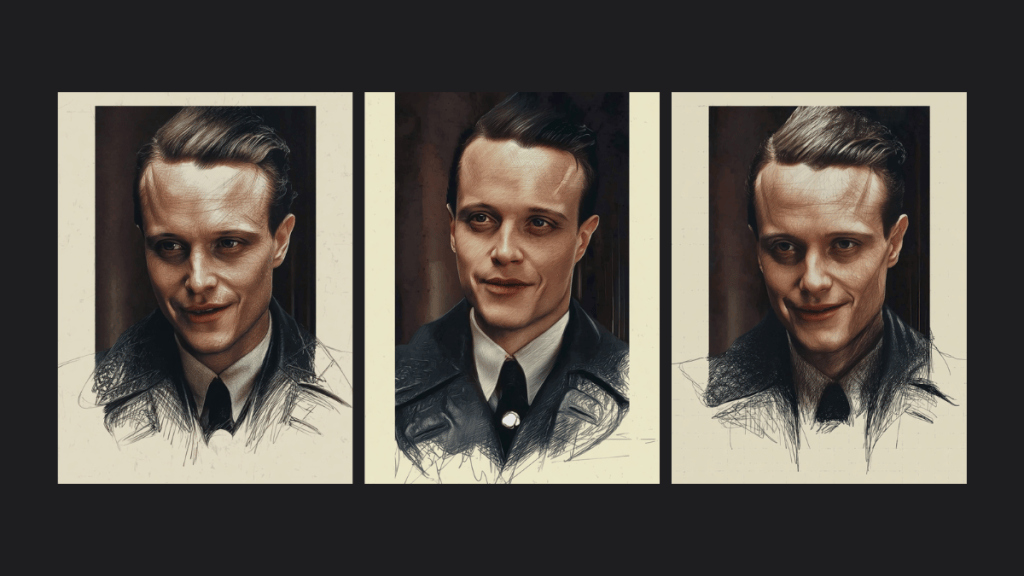
To someone who found Voight genuinely unattractive, the illusion of elegance completely collapsed, leaving behind only the grotesque machinery of an authoritarian archetype. Where an admirer would see tragic poetry, a detractor would see an unsettling caricature of cruelty and biological stagnation. Looking at his face and seeing nothing but an offensive, sterile asymmetry. That wide, pale forehead wouldn’t look like marble, then; it’d look like an oppressive, chalky expanse of dead skin—cold, clammy, and unpleasantly smooth, the underbelly of a blind cave fish. The immaculate, slicked-back discipline of his dark hair would lose its luster and appear greasy, plastered against his skull with a desperate, clinical vanity that tried and fails to hide a thinning hairline or a bulbous skull shape. His features would seem entirely unsuited to each other: the sharp, predatory ridge of his nose would look cartoonishly long and hawkish, while his high cheekbones would appear gaunt and skeletal, making his face look like a fleshless skull stretched over a bureaucrat’s desk.
His hands, earlier alive with a restless, arachnid choreography—fingers drumming, knuckles cracking, the signet ring tapped against oak in a spastic code—now lay motionless on the desk. Each finger resting in its own small pool of silence, aligned with the discipline of a thing no longer at war with its own nerves. The tremor that’d run through them like a distant, continuous earthquake had been reabsorbed into the bone, leaving only stillness. Of a held breath, of a cocked hammer, of something that’d finished its interior weather and settled into a single, unwavering pressure.
She could hear it in his breathing.
Before, there’d been a raggedness: the shallow, irregular sip of air that spoke of a heart pacing its cage, or else the opiate drone so slow it threatened to forget its next inhalation. Now the rhythm had found a center. Each breath came measured, deliberate, a slow tide that barely disturbed the black wool of his tunic. The breathing of a man counting, or a man who’d removed himself from the animal urgencies of the body and now operated on some colder, more efficient fuel. His gaze had shed its earlier extremes. The pupils no longer swam in the pinned-down vacancy of the poppy, nor did they dilate into the black, predatory saucers of the crystalline rush. They’d settled into an expanse of snow, a winter sky at noon, and they held her with a fixity that was almost physical. No flicker to the corners of the room. No tracking of phantoms across the ceiling. Only her. The steadiness of it was a new kind of assault, one that didn’t jab but pressed, slowly, until the bruise rose.
The disordered, chemical crackle that’d leaked from his presence—a static of clenched jaws and twitching tendons, the muffled, dreamy hum of a mind half-dissolved—had drained away. What remained was a vacuum, a negative charge, a clarity so absolute it had its own gravity. The air, which had been holding its breath against his volatility, now held it against something far more terrible: his attention, undiluted, no longer drifting on any current but its own malevolent will.
“We took a circuitous route to get here,” she remarked.
He rose without preamble—a single, oiled motion that unhinged him from the chair and sent it rolling back a few neglected inches. The sound of his boots on the Persian rug was muffled, rhythmic, unhurried. Three strides. Four. The floorboards beneath the carpet registered his passage in low, mammalian groans, the kind of sound an old house made when it was trying to remember something it’d been told to forget. Stopping before her. The black wool of his tunic filling her vision, a wall of darkness breathing faintly with the scent of cedar and something chemical beneath. His hand rose and cupped her jaw. The palm settled along the curve of bone, the fingers curled around the angle where mandible met skull, and the grip was absolute.
The index finger traced the inferior border from chin to angle, pressing with the calibrated force of someone who’d learned anatomy not from books but from the body’s own complaints. It stopped at the swelling—a hot, ripened mound beneath the skin—and depressed into it, softly at first, then with incremental depth, reading the tissue’s resistance like a blind man read Braille. The flesh yielded, fought back, yielded again. He noted the rebound. Noted the heat. Noted the fine, wet crackle of fluid under pressure, too deep to be surface, too superficial to be fracture.
His thumb rose to the temporomandibular joint, just in front of the ear’s small, shell-like whorl. He pressed in and asked a silent question of the hinge. She flinched—a sharp, involuntary recoil that traveled from her spine to her heels—but his other hand had already come up to the crown of her head, not gripping, simply present, a ceiling against which her movement ended. Now both hands worked together. Cupping each side of her jaw, thumbs beneath the chin, exerting a gentle, downward pressure. She opened her mouth—she had no choice—and he studied the architecture of its opening. Did it deviate? Did the chin swing true? He guided the mandible laterally, left, right, feeling for the grinding irregularity of a step-off in the bone, the dissonant rasp of one fragment singing against its neighbor. There was none. Only the smooth, obedient glide of intact anatomy, the mechanics of a hinge that’d been struck but not sundered.
He let her mouth close. His thumbs retraced their path along the angles, checking for asymmetry, for the subtle, geological lift of a displaced condyle. He palpated the zygomatic arch, the infraorbital rim, working upward from the wreckage of her lower face to the fortress of the skull. Each touch was methodical, disinterested, a surveyor mapping terrain that happened to be alive. Her breath, shallow and rapid, fogged the cuff of his uniform; he didn’t notice. Her eyes, wet but unblinking, searched his face for cruelty or mercy; they found neither. They found a man palpating bone, and nothing more.
The examination ended as abruptly as it’d begun. His hands leaving her face without ceremony, returning to his sides like tools to a belt. He turned. The boots retraced their path—three strides, four, the floorboards repeating their elegy in reverse—and the chair received him with its own soft groan of leather. His hands resumed their former position on the desk, each finger finding its precise, remembered station, and the room rebuilt its silence around them both like ice forming over a winter pond.
“Contusion of the mandible with associated hematoma and traumatic edema. No fracture.” The details meant to be striking would instead repel them. Those crystalline blue eyes wouldn’t look like sunlit ice; they’d look like a puddle of stagnant, chemical sludge—pale, unblinking, and entirely devoid of human empathy, framed by sickly, invisible lashes that gave him the bug-eyed expression of a nocturnal predator. His surprisingly full mouth, far from being a classical bow, would look swollen and soft against his rigid jawline, an unpleasantly fleshy anomaly on an otherwise bloodless face.
“It’s bruised, not broken.” And it was the gaze of a mind that’d entirely separated itself from the ego, watching a situation unfold with a chilling, mathematical exactitude that made his stillness feel like a countdown. “The edema will reach its apex within forty-eight hours.” His voice was the final, trapping mechanism of his design, possessing a texture that completely reconciled the bureaucratic coldness with the gentleman’s son. It didn’t boom; rather, it entered the room with a low, weighted resonance of a cello played in an empty stone chapel. There was a dark, velvet depth to his register, a rich baritone vibrating at a frequency designed to be felt in the listener’s chest before the words were even processed. The terrifying beauty of his speech lay in its absolute, unhurried cadence.
“You’ll observe discoloration migrating inferiorly along the mandibular border—purple, then oche, then a faint greenish yellow as the hemoglobin breaks down. This is normal. This is the body performing its function.” He spoke with a terrifyingly clean articulation, every consonant clipped with razor-like precision, every vowel smooth and unblemished by human warmth. It was the cadence of a man who’d never had to shout to be heard, a voice completely accustomed to absolute compliance. “The ecchymosis will pool at the lowest point of the jaw. Gravity is reliable. You’ll feel it as a tenderness, a heat, a dull pressure that will make chewing unpleasant for perhaps a week. I would advise against speaking unnecessarily—” A pause. “But that advice, in my experience, is rarely heeded.”
Her response was unhurried, almost ceremonial: a slow, deliberate ascent from the wrist, as if the hand itself was weary of the world. Her fingers curled inward one by one, a gradual folding, each knuckle bending with the quiet deliberation of a closing gate. The thumb tucked itself away, a silent accomplice. And then, alone, the middle finger rose. It didn’t snap up. It didn’t jab at the air. It simply unfurled, a pale, defiant spire against the slack backdrop of the other fingers. A digit straightened with a kind of regal disdain, a monument erected in real time. The knuckle blanching slightly, the tendon on the back of the hand pulling taut like a wire.
Her wrist held steady, almost languid, as if she were presenting a fine piece of jewelry rather than a vulgar hieroglyph. The nail, once painted a dark, bruised plum, caught the light. The gesture was utterly still, unshaken—a silent, sculptural fuck you that rang louder than any shout. She didn’t even need to look at it. Her gaze remained fixed on his, level and cold, while the hand simply spoke for her: a mute, unmistakable, and deeply eloquent tribute.

Leave a Reply