WARNING: this chapter is graphic. And I don’t mean in the fun sense. SA is abhorrent and it’s also a fact of war and it’s here because we (collectively, as a society) owe a duty of witness. A major element of this book and this series is contrasting the propaganda with the reality, how different people depending on their privilege and etc can experience the same world entirely differently. See also: the US, this morning. Representation is not endorsement! That being said, I found writing certain segments of this chapter stomach-churning and I’m the writer. So let me know in the comments and, if it’s something anyone’s interested in, I’ll add breaks so those who want to can skip them.
Seething rage crested like a wave she’d been riding without realizing, a long, slow swell that’d been building since first cough, since the kettle’s whistle and the mailman’s skull and every sleepless night thereafter. It broke over her now, hot and caustic, and she let it. She was tired of swallowing it down, tired of the way unease sat in her stomach like a stone she couldn’t digest. So she let herself think the thing she’d never allowed herself to think, the thought that’d been waiting in the dark of her mind like a spider in a corner, patient and venomous.
Charlotte spoke German.
Charlotte’s family was German. Her parents had fled religious persecution, yes—Jehovah’s Witnesses, neutral in all political affairs, pacifists to the bone—and Charlotte’s father had preached against Reich with a passion almost embarrassing in its sincerity. Railed against its injustices, indeed, at every opportunity, writing letters to newspapers all over America, refusing to let his language die in his household because it was the language of Goethe and Schiller, too, not just of Hitler and Goebbels. He’d taught Charlotte to sing “Die Gedanken sind frei” before she could walk and Constance knew all of this. But the rage didn’t care about fair. The rage wanted to hurt and be hurt, wanted to find some explanation for why Charlotte drifted through the apocalypse like a ghost while Constance scrabbled in the dirt, and the explanation it offered was the ugliest one available: Charlotte was one of them. This was her people, the soldiers slouching on the cracked stone ledge, the ones with the guns and the dented flask, the ones who’d taken her city and her family and her future—they were Charlotte’s countrymen. She had their Bavarian features, that hair, the infuriating ability to look beautiful while the world burned, just like the officers traipsing around through the rubble and somewhere, in some alternate universe where her grandparents had remained Catholic, Charlotte would be sitting in a drawing room with a view of the Alps, still painting her stupid mush, while Constance and everyone like her were ash.
And Zelda! Zelda was even worse, somehow. Zelda, who acted like a child stomping her foot at bedtime, who didn’t take the resistance seriously and didn’t seem to understand, either, that her “harmless” pranks would get her killed. Liberating the engine from a Mark X Panzer, delivered in that George Carlin deadpan. Constance could see it as clearly as if she’d been there: Samus Aran, Jr. in the dead of night, her concertina-wrapped bat slung across her back, creeping toward a parked tank with a socket wrench and that shit-eating grin. She’d probably quoted Sam Adams while she did it, whispered some Revolutionary War platitude about tyranny and the rights of free men while unscrewing bolts from a sixty-ton death machine. And for what? To inconvenience a crew of soldiers who’d simply commandeer another tank, who’d blame some motor pool mechanic and never dream that it’d been some skinny creature quoting dead patriots at the moon.
It wasn’t resistance. It was suicide with extra steps. It was a child playing at war while the adults did the dying.
Must be nice, she decided sourly. Picasso Jr. and Sophie Scholl, the redux, for whom the Gestapo’s fliers were polite suggestions. Charlotte had lost the Louisville Slugger, their one weapon, and had apparently decided that painting the Nazis would be an adequate substitute. Perhaps she could capture their souls on canvas, render them powerless through the transformative magic of art. Perhaps she could forgive them while they kicked down the door, or share some of her church’s exciting pamphlets! Zelda, meanwhile, would charge a whole platoon, and she’d die, and Charlotte would paint a very moving tribute to her sacrifice, and Constance would be the one to bury what was left.
Into the silence of her mind, drunken laughter, echoing off broken brick walls.
Chinatown—no, the Chinese Residential District now, as the Reich insisted it be called, as if renaming a place could erase the people who’d lived there, as if the famous gate still standing at its entrance now marked nothing but a pen—had been one of the hardest-hit neighborhoods during the bombings. Constance remembered coming here as a girl, holding her father’s hand, watching the lions guard the gate with their stone paws raised in welcome. The restaurants had spilled light onto the sidewalk, red lanterns swaying in the breeze, the smell of roast duck and scallion pancakes drifting through the streets like a promise. Tourists had thronged toward the gate, cameras ready, eager to consume a version of China that could be photographed and forgotten. Now the tourists were gone, and the lanterns were gone, and the only thing drifting through the streets was the sour stench of rotting corpse and sewage. Trash rustled in the hot wind, skittering across the pavement like nervous animals. The skeletal frames of buildings loomed, their blown-out windows staring blankly, like empty eyes watching the streets below. Hiding God knew what, God knew who.
And this was the ghetto now. The Warsaw Ghetto, all over again, because the Reich had never stopped building ghettos. They’d been building them for fifty years, across Europe, across across the occupied territories, and now they were building them here. The Chinese Residential District wasn’t some vague homage to Warsaw—it was the same project, the same machinery, the same meticulous cruelty running on the same fuel. The Reich didn’t need to study old photographs and old reports because the men who’d written those reports had trained the men who trained these men. The institutional memory was unbroken. Grandfathers in SS offices had passed down their methods to fathers, who’d passed them down to sons, and the process had only grown more efficient with practice.
First, the designation—Chinese Residential District, a name that sounded administrative, bureaucratic, almost benign, the kind of phrase you could repeat at a press conference without flinching. Then the walls, not built all at once but erected in pieces, a checkpoint here, a barricade there, concrete barriers and razor wire appearing overnight like mushrooms after rain, until one morning certain residents woke and discovered they couldn’t leave. Then the crowding, as families from Dorchester and Quincy and Malden were relocated into the district, dozens of people crammed into apartments meant for four, six, eight. Then the hunger, as rations were cut and cut again, as the black market became the only market, as people began to trade everything they owned—their grandmother’s jewelry, their wedding rings, their children’s shoes—for a single meal. And through it all, the guards. Thugs from the SS-Totenkopfverbände, the Death’s Head units, the same men whose fathers and grandfathers had worn the same black uniforms and guarded the same kinds of walls in Minsk and Krakow and a hundred other cities the Reich had hollowed out and filled with the helpless. A direct, unbroken line from 1942 to 1994, from Warsaw to this now desolate dead end, where Constance had once held her father’s hand and felt safe.
At least the Chinese themselves had escaped.
Because China had made peace with the Reich. Or the Reich had made peace with China, depending on whose propaganda she consulted. But the racial theorists of the SS-Schulungsamt had confronted a problem postwar their foundational texts had never anticipated: a superior superior race. The United Republic of China was a sovereign, nuclear-armed empire that’d unmanned Japan and threatened to bomb Berlin back into the Stone Age. Further aggression was impossible; the Reich would lose. So the Kulturtheoretiker, in its wisdom, rejiggered the framework. Not a single ladder of racial worth, now, that’d been a mistake! Instead there were parallel hierarchies, each civilization with its own apex. The Germanic race crowned the European hierarchy, obviously but the Chinese race, the sinische Rasse, crowned the East Asian and so the Chinese were no longer a threat to racial theory but proof of it, a mirror image of the Reich’s own dominion. Huzzah!
But the pit still had a bottom.
Several bottoms, in fact, the categories of people who’d never get to be reclassified. Someone needed to be Untermensch, that was the point of the system. The Jews, of course, the original target, whose eradication had been pursued around the globe with the same relentless, industrial patience. The Roma and Sinti, too, of course, resistant and troublesome, others no empire had thought to claim. The disabled, the deformed, the life unworthy of life and wasn’t shutting their useless mouths doing the whole world a favor? Homosexuals, pinned with pink triangles and worked to death alongside communists and anarchists and whoever had dared to suggest, from the pulpit, that Jesus might not approve. Sent here to the ghettos, the forgotten basement of the elite, the swirling sink beneath the temple that fed into its sprawling sewer.
And its rats?
The Totenkopfverbände, the death’s head guards, the detritus their comrades would like to forget. Plaster them over with reassuring posters, strong-chinned men gazing into a victorious future, the Waffen-SS were real soldiers! No different than the 75th Ranger Regiment or the Special Air Service, men with real teeth who could follow an order without their minds wandering off and some were even promoted to the Allgemeine-SS, riding desks for the Führer what fun. Or investigating crimes, what the Reich called policework, but even the Gestapo needed men who’d passed third grade. Who were few and bar between, as it turned out; breeding men like poodles might almost be a bad idea?
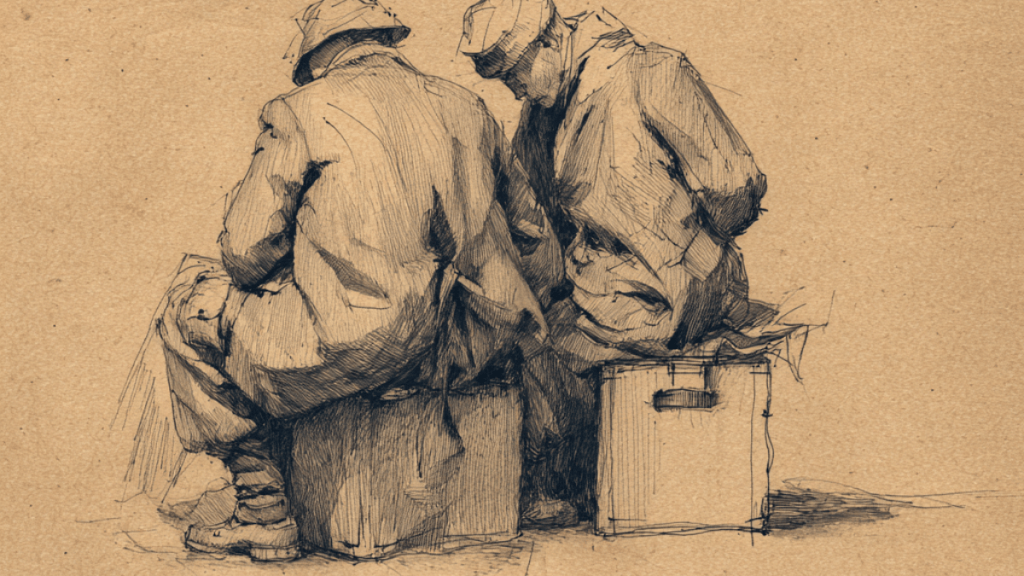
You washed out of the Waffen-SS because you couldn’t march a straight line, because you wept during live-fire exercises, because you were caught with a bottle in your footlocker for the third time and the fourth and the fifth. You were too ugly to stand at attention during a state visit, your face a relief map of old brawls and bad decisions. You were too stupid to fill out a requisition form, too drunk to pass morning inspection, too damaged—the head wound that changed your personality, the shell-shock that left you staring at walls, the thing that snapped behind your eyes at San Gabriel or the Mojave and never snapped back and now you pissed in the officers’ boots. The Reich couldn’t put you on a poster. The Reich couldn’t even put you in a uniform and march you past a reviewing stand without the foreign press corps having a field day. So they sent you here. They gave you a wall to sit on. They gave you a ghetto to guard.
These two could complete the 300-meter swim in under ten minutes; it was doubtful if either could spell his own name. Both had been declared the biological vanguard of the master race; other SS men crossed the street to avoid them.
Here was the grease trap of the master race, the ass-end of the thousand-year Reich, two men so thoroughly discarded by their own organization that they’d been shipped to the middle of nowhere. Singing, tuneless and bleary, while the sun cooked the last few brain cells rattling around in their skulls. And if another SS man walked past—a real one, with polished jackboots and a crisp collar and a chest full of campaign ribbons—he’d look at those two on the wall, and he’d feel something curdle in his stomach. Pity was weakness, so not that. Disgust, she supposed, the cold, professional disgust of a man who’d worked hard to be beautiful and brutal, who didn’t like being reminded that beneath the uniform, beneath the marching and the medals and the myth, it all eventually drained down to this.
Ruined walls seemed to incline toward one another overhead, their silhouettes losing the straight lines of architecture and taking on the organic slump of something listening. She could almost feel the tilt in her bones, a gentle vertigo, as if the city itself had craned its neck to watch. No glass left to catch the sun, just a faint gleam on the splintered sills where rain had pooled and gone stagnant. And in the deepest part of those dark interiors, shapes that might’ve been drapes or shredded wallpaper hung motionless. The waiting was a slow pulse in the air, patient and certain.
Then, almost on cue: the scrape.
From the far end of the street, a deliberate drag of sole on grit. Beavis lifted his head with the slow, underwater gravity of a reptile registering vibration. Holding the pose for a beat, two beats, then—a loose, liquid roll of his shoulders, whatever, tilting the flask to his lips. The rubbing alcohol or whatever it was caught in the stubble on his chin and dripped. Butthead, though, was staring. Lower lip sagging, a thread of saliva stretching between his cracked lips, thick and pearlescent, trembling with his breath. Hanging there, a single bright filament, and for a moment it caught the jaundiced light like a jewel. Then snapped, leaving a glistening trail down his chin. His rictus grin was peeling back, the mirth cracking like old paint, and what lived beneath was not humor.
It was hunger.
The woman was hunched in the intersection, a sack of skin draped over a frame of sticks, hollowed out to the point where she might’ve been eighteen or three times that. Desperation had driven her from whatever hole she’d been hiding in, but she saw the men and froze. Run, Constance wanted to scream. But the woman just stared as Beavis rose. And he was in no rush, the movement languid, almost liquid, a slow uncoiling that had nothing to do with who he’d been ten seconds ago. His lolling head steadied. His eyes, which had been sliding in and out of focus like a badly tuned signal, locked onto her with a clarity that was worse than the vacancy. The stagger evaporated. He was balanced now, centered, his weight shifting to the balls of his feet with an ease that spoke of muscle memory, of a body that knew exactly what it was for. He didn’t look stupid anymore. He didn’t look like anything at all—just a shape, a function, a predator whose only remaining feature was intent.
Butthead rose beside him, another jackal roused by the scent of prey. His frame was softer, his movements less efficient, but the grin had widened into something that showed teeth—yellow, jagged, crowded like headstones in a forgotten cemetery. A low sound escaped him, not quite a laugh and not quite a growl, just air moving over vocal cords that hadn’t been used for much in a long time. They stood shoulder to shoulder now, two figures black against the leaning buildings, the windows above them still and dark and watching as the woman shrank in on herself.
A sparrow heartbeat visible in the hollow of her throat.
The street held its breath.
Butthead laughed and reached for her, fingers curling like claws before flicking under her chin in a mockery of tenderness. Said something Constance’s brain refused to process, still crouched behind her dumpster. Watching as the woman’s breath hitched, yanking the girl into her arms, holding her close, shaking with the effort. Butthead only grinned wider. The woman’s shoulders sagged as her grip on herself tightened, not in protection but in resignation. Her mouth trembled, trying to form a plea that wouldn’t come. And, in a split Constance saw it happen: the woman aged. She knew what was about to happen, even if the girl didn’t, knew no help was coming.
Do something, a voice snapped in Constance’s head.
But she didn’t move.
She only crept deeper into the shadows, shame burning like acid in her chest.
Then—oh God.
The girl came up from behind like a shadow detaching itself from the wall, from her—sister, mother? She moved exaggerated care, placing each foot as if the ground were thinning ice, stepping in front, ignoring the woman’s efforts to push her back. No, the protest, as small as her voice. Caught in a cruel in-between: just the faintest suggestion of curves at the hip and chest, a softness that hadn’t decided what it’d become. Too old to be quite a child, too young to be anything else, trapped in that liminal space where the world already saw her as prey but hadn’t yet armed her to fight back. Her hair hung in lank strings, the color indeterminate under layers of dust, and her eyes—large, dark, too knowing—held the soldiers’. “Leave us alone.”
Beavis swaggered forward, thumbs hooked into his belt with a cowboy’s insolent roll. He grunted, chucking her under the chin. “Tell us, doll, what’s this old whore snooping around for?” Conversational and casual, his tongue thick with alcohol or the unfamiliar language or both.
Each word a fresh blow, the woman recoiling. “Something to eat.” Hoarse and paper-thin, vocal cords sanded down to almost nothing. It wasn’t a plea, Constance knew, or even an explanation. It was just the truth, stripped down to the bare fact of her need. There was water out here, collecting in the gutters, the half-sucked candies the soldiers spat out and discarded.
The girl pressed into her side, small fingers gripping the worn fabric of the woman’s shirt with a desperation that spoke of long practice. The cloth bunched in her fist, threadbare cotton that had been washed in puddles and dried in wind, and she held on as if letting go meant falling off the edge of the world. Not her daughter. Not truly. The angles of their faces told different stories, their skin carried different shades of despair. But war didn’t care about blood; war made families of whoever was left, whoever would hold your hand in the dark and not let go.
The woman’s eyes darted, desperate, pinging from shadow to shadow. Past Constance, past whoever else shared the silence. And when no help appeared, when the street remained a hollow throat waiting to swallow, she swallowed instead. Gathering the last scraps of her dignity around her like a threadbare coat, shoulders squaring. “Excuse us,” she began, “but we—”
Butthead struck.
The shove came without warning, without telegraphing, without the cinematic courtesy of aggression building to a climax. Just a blur of motion and then the flat of his palm against her sternum, hard enough to send her stumbling backward. Her arms wheeled, feet fighting for purchase on the cracked asphalt, the girl’s grip tearing free with a sound like fabric ripping. Or maybe that was just the world, Constance thought, coming apart. Silent now, the only sound a rushing in her ears.
The girl squeaked. The sound was small, sharp, terrified—a rabbit’s cry, a bird’s alarm call, a noise too high and too quick to be called a scream. It hung in the air for a fraction of a second before the street swallowed it too, and then there was only the woman struggling to stay upright, her shadow stretching long and jagged across the ground, two soldiers standing between her and everywhere else.
And Constance knew.
What was coming, what was coming after. Years of siege meant this was no woman’s first rodeo and what was she supposed to do? Announce herself in all her rayon-clad glory, a should-be-in college girl reeking of eau de Port-o-John, her hair a nest of grease and neglect, her hands soft from a lifetime of nothing useful? Stand between those hyenas and their prey and offer herself in the girl’s place—as if her thin, tired body could serve as any kind of substitute? Get in line, kid. She’d be first, was all, and she hadn’t survived this long to be stupid.
So she watched, safe, as Beavis lumbered forward.
Joining his companion with the slow gait of something built for breaking. Bloated lips curling, grin spreading across his face like a crack in rotting fruit, mirroring Butthead’s. “You want some food?” Singsong, almost cheerful, his voice a wet and gloating thing that seemed to savor itself. He shoved the woman next, harder this time, his palm connecting with her shoulder with a flat, echoing thud. Watched her stumble again, watched the fear flicker like a blown bulb struggling to stay lit.
He liked it.
“You’re not worth food.” Butthead’s breath came in ragged puffs. He was the taller of the two, though both of them shared that same square build, frames assembled from spare parts and bad intentions. He reached out, squeezing, testing a melon for ripeness. “You’re not worth a boot to the ass.”
Twin peals of laughter tore through the stagnant air like a saw through wet wood, loud and ragged and utterly without mirth.
The silence threw the noise back at them, windows swallowing nothing, giving nothing. The woman flinched, her whole body curling inward as if she could fold herself around the girl and disappear into some smaller dimension where men like this couldn’t reach. Tighter against her chest, pressing that small, trembling form into the hollow of her ribs, that thin shield of bone and skin and desperate, futile love. As if it could stop them. As if anything could.
This time, Beavis’s hand that reached out. The movement was almost lazy, almost tender, the way a collector might brush dust from a porcelain figurine. His fingers—rough, clumsy, the knuckles scarred and the nails black with grime—grazed the girl’s cheek with a gentleness infinitely worse than violence. “This one’s ripe.” His voice dropped, low and thick with anticipation, a murmur that was almost intimate. “She’s too thin, but she’ll do for a bit of fun.”
Please.
The woman mouthed the word. Her lips shaped it, the p and the l and the soft sibilant finish, but no sound emerged. Her throat had closed, or Constance’s had, sound lost in the whump whump whump. Her eyes were wide and shining, tears trembling on the lower lids. The girl trembled in her grasp, a leaf in a wind that would never stop blowing, her small body vibrating with a frequency of terror that seemed to hum in the air itself. But it didn’t matter, not now. Nothing did.
Please hung between them, unspoken and unheard, a prayer directed at a god that had abandoned this street long ago. The soldiers didn’t see it. Or if they saw it, they saw it as seasoning, as garnish, as the final trembling ingredient that made the meal complete. The sun continued its indifferent arc. The windows continued their silent vigil. And the girl continued to tremble, a heartbeat wrapped in skin and terror, caught in the space between what was about to happen and what could never be undone.
Beavis yanked the girl toward him.
Fabric ripped through the dead air, seams that’d held through 648 days of siege finally surrendering. The girl’s sleeve separated from her shoulder, torn edge fluttering. Butthead’s hands were everywhere already, pawing at her chest with a blind and fumbling urgency. Sausage-like fingers groped through the threadbare cotton, bunching and twisting under his palms. She whimpered, twisted, her narrow shoulders wrenching as she tried to pull back, become smoke, become nothing at all.
A cuff to the side of her head, in warning.
Then Butthead joined him, grip a manacle of meat and bone, his own fingers digging into soft flesh of her upper arm. Hard enough to brand her, leaving ghosts of himself in the bruise that would bloom there tomorrow—if tomorrow came. Then he was on her, too, leaning down, mouth open and wet and Constance’s knuckles were in her mouth. Lips peeled back from those headstone teeth, breathing loud and ragged, clutching at whatever their hands found: the just of a hip, the curve of a rib, the flat plane of a stomach that’d never known fullness. Laugher blurring with the girls’ cries, the two sounds twisting together into something that was neither one nor the other, a third thing born of the collision, a sound that’d curdle milk and haunt quiet rooms and make the dead spin in their graves.
Constance couldn’t hear the woman’s shrieks.
Her mouth was open, throat straining, veins in her neck standing out like cords but all that reached her was a roaring pressure. And in it she saw the crack of the backhand. Frame by frame, the arc of Butthead’s arm, the flat of his hand, the casual connection with the woman’s cheek. Reeling backward this time, dropping like a sack of potatoes. Hitting the ground with a thud that Constance felt in her own bones, a dull percussion that traveled up through the asphalt and into her feet and lodged there.
Time was a photograph, a diorama.
The soldiers, intent on their prize, didn’t spare the fallen woman another glance. She was nothing now, less than nothing, an obstacle they had already stepped over. Their backs were to her, their shoulders hunched, their bodies forming a wall of uniformed flesh around the girl’s small, jerking form. Face down on the asphalt, choking on her own sobs. Her fingers clawed weakly at the ground, the nails bending back, scraping grooves into the dirt and grit. Her spine curled, her shoulders drawing inward, her whole body contracting into itself with a desperation that was almost fetal. She was smaller than she’d been a minute ago. Smaller and older and curling in on herself, as if she could disappear, as if the world might forget her, as if shrinking enough might make her invisible.
Make it invisible, whatever came next.
And Constance—
Constance just stared.
Poleaxed. That was the word, if words still mattered. A blow to the skull, a blade between the eyes, a clean severing of thought from action. She stood there behind whatever scant cover the alley offered—a dumpster, a broken pallet, the shadows pooling between crumbling bricks—and she stared. Her breath came in shallow, uneven gasps, each inhale a sharp little sips of air that never quite reached her lungs, but she barely noticed. Her body was doing things without her permission, running its animal functions on emergency power while the rest of her crouched very still and very far away.
Wave after wave of revulsion crashed over her, each one a wall of ice water, knocking the wind from her and before she could gasp for relief the second was already rising, already breaking, already dragging her under. The dumpster spun in slow, sickening circles, the leaning buildings tilting on their axes, the pale vault of an indifferent Heaven swapping places with the ground. A noise in the other room, her pain, a house ten streets over, a world apart, palms pressing against her eyes. Grinding deep into the sockets, the heels of her hand digging. Wondering if blindness would be a mercy, if the ground would catch her if she collapsed, or just let her fall through.
Was she crying?
She couldn’t feel the tears erupting, couldn’t feel the wetness on her cheeks, couldn’t distinguish it from the cold sweat that’d broken out along her hairline and now bathed her face. The question seemed immensely unimportant, an administrative detail filed by some clerk in a part of her brain that was still trying to keep the lights on. But warring with the terror—and the disgust was there too, a greasy film coating everything—was something else. Shameful and glistening, flooding her chest and warming her extremities even as it knotted her stomach: relief. Someone else was suffering, someone else was being torn apart behind that wall of uniformed flesh, someone else’s cries were filling the air—and that meant it wasn’t her.
Alone with her own self-hatred.
This is who you are, it whispered. This is what you’re made of. You’ll stand in the shadows and press your hands to your eyes and thank whatever god is left that it’s her and not you. And it sounded like her father’s voice, pressing her palms in deeper to grind it out, pressing until the phosphenes became needles, until the pain was almost enough to drown out his relentless tone. Hidden as the shriek crescendoed and snapped and she jackknifed forward, gagging.
Her mouth opened in a wet, retching gasp that ping-ponged around her skull, the sour burn of bile flooding her throat. A chemical scald, whimpering as thin gruel spilled past her lips, splattering onto her shoes in a pale ribbon. She remembered those chunks from high school, accusing her from the Tupperware she hid in her closet. Until her mother complained, and started to search the house and—
There wasn’t much. Not this time. Breakfast had been a tube of pea soup concentrate she’d squeezed into her mouth while arguing with Zelda, the paste oozing over her tongue like something already half-digested. Which tasted as bad coming up, she reflected, as it had going down. A familiar toothpaste texture, gritty and slick at once and even the same sickly green! Her stomach signaled its agreement with another backflip. She could feel it moving inside her, a wet, muscular convulsion, and she spat—once, twice—trying to clear the taste from her mouth.
And then she looked up.
The woman was staggering upright. Rising from the asphalt like something dredged from deep water, her movements slow and unsteady, her legs barely holding. She tottered forward, weightless and broken, a marionette with half its strings cut, drifting toward the gap between the buildings where the soldiers had dragged the girl. Her arms hung loose at her sides. Her head lolled. But she was moving, impossibly moving, drawn forward by a tether that had nothing to do with muscle or bone and everything to do with whatever remained of her heart.
Shakily, Constance rose. She’d follow this time, do something to—
The hand came out of nowhere.
Out of the dark, out of the damp, out of the space between one heartbeat and the next, clamping down on her wrist.
Hard.
The cold of it registered first, a cold that had nothing to do with weather and everything to do with the grave, a cold that seeped through her skin and into the marrow before her nerves could even fire. Then the shape of it: bone-thin fingers, each joint a knot, each knuckle a knob of cartilage wrapped in skin that felt like old parchment, like something that’d been left too long in a drawer. Digging into her like talons curling around a perch, and she shrieked. Yanking her arm back on pure instinct, revulsion that started in her shoulder and shot down her spine. Like a whip crack, and the grip tightened.
Impossibly strong. That was the first coherent thought that surfaced through the static of her panic. Fragile as twigs, these fingers, the kind she could snap without effort. Yet gripping on with the tensile strength of rusted wire, the kind that cut before it gave. The pressure ground tendon against bone, index hooking over the ridge of her radius, middle and ring violating the soft underside of her wrist where her veins ran blue and close to the surface. Thickened and cracked and rimmed with something granular, each nail pressing its own pale crescent into her skin.
“Enough of that,” the creature hissed. Its tone carried equal parts fear and dismissal, the tone of something that’d seen too much to be patient and too little to be kind. Wet and warm, just behind her left ear, stirring the fine hair along her neck. Sour, that breath, the ghost of whatever it’d last eaten. “Those two will be back soon.” A tug. “We don’t want them investigating.”
We.
Constance turned, into a gaze glazed with wetness that seemed stolen from something living, two polished marbles sunk deep into over-proofed dough. A puckered ruin, left to rot with the rest of her, robed in grime so thick she could’ve peeled it back in strips. The smell hit her full-on now, revealing the sour milk foundation. Sweat-soured Band-Aid over that, fungal and sweet, mixed with monkey cage. A hot and animal closeness, bundled in a blanket that’d lost its color to time, edges fraying to a lace of loose threads and trapped debris. And in the crone’s hand, a stick. Crooked as a question mark, stripped of bark in spiraling ribbons that left the wood pale and porous as old bone. Blackened and brittle where the bark hung on, the end had been…gnawed. Worked into a wet, fraying brush, each splinter dark with saliva and worn soft as felt; deep in the cracks, something darker had settled and dried—sap, perhaps, or blood, or the slow seep of a tree’s last confession. And Constance, feeling the warm pulse of her own blood against those cracked nails, understood that she hadn’t been grabbed—she’d been chosen. By a woman who, she devoutly hoped, had a dog.
If it was a woman.
Visions of Mr. Warren flashed in her mind.
The crone’s grip slackened all at once, a sudden absence of pressure that left the blood rushing back to Constance’s wrist in a hot, needling flood. But she’d already turned, rustling with a sound like dry corn husks, tottering back into shadow. Then paused, jerking her chin, the gesture of someone accustomed to being obeyed. But Constance could only stare, flinching with each tap-tap of the stick. A body cobbled together from old pains, she couldn’t…she couldn’t be a cannibal, right? Or if she was, Constance could at least outrun her. Him. It. And the soldiers had guns.
She lurched forward.
Before her mind could object, shoes slapping pavement in quick, uneven bursts, the sound too loud and too fast and too much like running. Into a wall, she’d thought—but the crone turned and vanished. No dead after all, this alley, bending sharply at the back into a jagged dogleg. Brick veiled in moss the color of old bruises, a seam in the city she’d passed a hundred times and never seen. Overhead, the façades blotted out the sun, tilting toward each other like exhausted mourners. Breathing a chill, damp exhalation that smelled of old cellars, of centuries of rain. Brick dust pattered down in thin streams, sifting through the cracks, and in its wake came the susurrus of lost voices. Not words, not quite, but the suggestion of them, pressed into the mortar and left to cure.
The crone ignored them, muttering to herself, a guttering stream of nonsense that her dentures seemed to agree with. Working against her loose gums, click-whistle-suck, the obscene percussion and this was the real Reich. Not Albert Speer’s promenades, but the riptide beneath their glittering marble, the undertow that pulled and never released and here back doors gaped into nothing, doors hanging askew on figures that seemed to hang half-formed. A cook squatting to smoke, his tobacco still curling, his friend leaning against crates stamped in Cantonese. None of them moved, just watched, patient as stone, their silence a warning that required no voice.
Turn back, it said. There is nothing here for the living.
But Constance moved forward, walls narrowing until her shoulders nearly brushed both sides. Streaked with old grease, black and gelatinous, over graffiti worn down to almost nothing. Shrapnel’s pock marks, even here, a constellation of small violences, mortar oozing out in calcified welts. Someone was watching, she could feel the itch. Whoever had hung the laundry overhead, bowing under its own damp weight. Dripping down on her, limp shirts with their arms dangling.
Down the rabbit hole.
Chasing the White Rabbit, through a tunnel of accumulation, sorrows layered like sediment, a city rebuilding itself on top of its own corpse. Would there be tea at the bottom, a grinning cat? We’re all mad here, the puddles seemed to whisper, and she was still falling. No dog, either, the crone didn’t like them. Snapping her stick against a sad specter that’d once been someone’s best friend, spitting as it flinched. Not with surprise but with a worn, practiced resignation, a creature that’d long ago learned not to hope. Hollow-flanked, its mangy coat clung to its bones like wet newspaper, the fur missing in patches. But the crone had stumped past, that infernal stick striking each riser with a dull, percussive knock. Thump, drag, thump, the sound of a body moving against its own decay.
She—he, it—pushed open a door.
Shelling had cratered the building, punching through the once-ornate plasterwork. Jagged cavities ringed with rust-colored bloom, the rebar inside exposed and weeping orange. Inside, Constance found some so-called stairs that were somehow worse. A curling spine of broken stone and buckled iron, the railings long since wrenched away for scrap. Pausing on the third step, she watched the crone ascend. Past peeling paint, the wall a palimpsest of grief and gallows humor, scrawled in a dozen hands. Chalk, charcoal, spray paint, something brownish that might have been blood. Marked doors mean death. Don’t knock. The letters on that last warning were tall and jagged, etched with a shard of glass by the look of the grooved plaster. Beneath it, in a smaller, shakier hand had added: Watch the windows—they’re watching back. Her throat tightened, cartilage clicking in the gloom.
If you hear singing, hide.
That one was written in what looked like axle grease, smeared by a passing hand, the words still glossy.
Someone had listed their children’s names in looping cursive. Lena, Tomas, Miri—April 14th. Each letter formed with the desperate precision of someone whose hands had become a sieve. Please, if you see them…. But the rest had been scrubbed out; two weeks was a long time. Someone else had drawn their children’s faces, with the same charcoal, over a wild scrawl that’d dripped where the can sputtered. For a good time, try escaping! Beneath that, a different hand had added, Soldiers can’t read, spread the word! And in a cramped, vindictive script, not paint this time but Sharpie: Reich dicks—smaller than our rations! And at eye level, right where the brick had spalled away to a shallow crater, someone had written in a hand so steady it was almost serene: Free rat meat—catch your own!
A sharp thump brought her back. The crone had reached the top of the stairs and brought her stick down against the doorframe, the sound ricocheting off the close walls. She shot Constance a look over the bony shelf of her shoulder and then she vanished inside, blanket trailing behind her like a shed skin.
Constance followed, gagged, and blinked.
A tattered dishrag semi-disguised a broken window, its fabric stiff and translucent with God knew what, staining the light a color reminiscent of scabies. Overhead, a bare bulb dangled from a frayed cord, its glass furred with dust; the crone flipped a switch and remembered, grunting. Moving further into a maze that revealed itself, as Constance’s eyes adjusted. That humped silhouette was a table, buried under drifts of catalogues and stacked plates, the dull gleam of something metallic beneath a shroud of Stop n’ Shop circulars, the whole of it breathing out the close, stale air of a tomb.
Rusted tin cans crowded the counter in precarious towers, their labels peeling away in long, curling ribbons to reveal streaks of black mold blooming up the metal like dark smoke frozen mid-rise. Among them, jars huddled in clusters, some filled with cloudy amber liquid in which…something trailed like drowned hair, others packed with scraps that floated mid-suspension, pale and puckered as preserved specimens in Frankenstein’s forgotten lab. A cupboard door sagged open on a single hinge, its shelves crammed with mismatched plates, each one caked in a mosaic of dried food so old it had cracked into patterns like desert earth, flecked with the dark, scattered grains of mouse droppings. Beneath, a coffee tin overflowed with bread scraps furred in blue-green mold, their edges soft and collapsing. And beside it, Constance saw, a chipped mug bristled with rusted forks and spoons, their handles tacky with something syrupy and dark. Open containers bled onto the chipped Formica: a box of crackers gone soft and sagging inward, a loaf of bread collapsed into its own hollow center, a lidless jar of something viscous alive with the black, humming industry of flies.
What might once have been a sink rose beneath a mountain of unwashed dishes—plates and bowls and cups stacked in teetering strata, their edges sealed together by a thick, viscous sludge that’d long since swallowed the bottom of the basin. A rusted knife balanced on the lip, its blade stained in a pattern that was too deliberate for rust, the dark smears feathering out along the edge. But the floor was worse: scraps of newspaper had fused to the linoleum, carapaces of forgotten bugs crunching underfoot with each step, the found faint and granular, half-buried beneath rags stiffened into rigid folds. And scattered among them, small and pale and unmistakable, yellowed bones. Long bones, knobby at the joints, split at the ends where the marrow had been sucked out.
Dog bones, she told herself.
Too small to be human, unless….
The crone stumped toward the oven, her shoes peeling away from the floor with each step—rip, a wet suck of contact breaking, stick, the soft adhesion of the next footfall, rip—the sound of a bandage lifted from a wound that had not yet begun to heal. Constance fought the flinch each time, the sympathetic wince that twitched in her jaw and tightened the skin around her eyes.
The stove had become a monument to abandonment, blackened pans and grease-crusted skillets heaped across its surface, stacked at angles, some warped enough to have slumped and fused into a single massive lump. As if the iron itself had given up and melted into its own ruin. A saucepan sat cold on a crooked burner, half-filled with something that had long since ceased to be stew, a congealed mass whose surface had scabbed into a leathery skin, bulging where gases had pushed up from beneath, then split open to bloom with blue-green mold that curled back in wet, papery scrolls, revealing darker, glistening growths beneath. More cans ringed the whole tableau in a loose semicircle, some so bloated with rot that their seams had split and leaked a slow, dark seepage across the enamel. Candles stood among them, burned down to stumps.
The crone muttered again, while Constance thought about Vick’s VapoRub.
Something shifted beneath a pile, the kitchen’s other inhabitants rearranging themselves in the dark.
“Sit.” The crone pointed. At a chair, or what had once been one.
You’re a guest. Her mother’s stern voice, this time. Her father had taken a powder. And so she sat, cushion receiving her with a moist sigh. Yielding, a concerningly cellular compression, as though it’d been stuffed with something that still remembered being alive. Dampness seeped through her skirt, a cold and spreading bloom against the backs of her thighs. She plastered on a grin. Ignoring the cloud that rose from the fabric, because she was a guest. Intimate and awful, the sweetish tang of discovering that rat behind the baseboard. “I’m Constance,” she announced.
Another noncommittal grunt. “And I’m not.”
The sudden cackle that followed felt like being electrocuted, trailing off into something that seemed to start somewhere in her chest and die before it reached her mouth. Leaving Constance to gape, blinking, as she reached for a dented kettle. That’d been through Blood Pass and come out the other side, enamel chipped to continents of bare metal. Reaching behind a wall of cereal boxes, producing a jug of—water? It came out in a slow, viscous trickle. But the crone only nodded, reaching for the matches. Skritch and the split-second flare, creases bared in bas relief.
She lit the burner.
Which didn’t catch, of course. There was nothing to catch—Boston hadn’t had oil since the winter of ’92. But the crone nodded, satisfied, setting the kettle down on the dead coil. A prized possession, her hand lingering on the handle, and then she began to hum. A tuneless, wavering thread of sound, pitched low in her throat, rising and falling without pattern. The hum of someone keeping company with a ghost. “You can call me Alice,” she added, not bothering to turn.
Constance’s smile was beginning to hurt. “Thank you, Alice.”
“For what?” Suspicious, not curious.
Constance’s hands found each other in her lap, fingers lacing and unlacing, the joints working against themselves. Her palms had gone damp, and the dampness made her own skin feel foreign against her fingers, slick and wrong, like touching someone else’s hand in the dark.
“For rescuing me.” The words came out high-pitched, plaintive. Rescuing. As if this were rescue. “From….” Her mouth opened as she tried to forge on, closing again on nothing. The soldiers, the flecks on her shoes. The white-faced woman, the glint of sun on a Karabiner 98k. Rising up all at once and jamming in her throat like a swallowed stone, and she sat there like the ninny she was and couldn’t name any of it, couldn’t finish the sentence that would make this real.
Alice leaned against the counter, arms folded over her chest. “I saw, girl. I saw.”
One ankle crossed over the other, stick propped within easy reach. Marking time, like a neighbor might agree that she’d seen a pigeon. And Constance could see herself doing it: reaching out, wringing that mass of knots that was Alice’s throat, feeling them shift. Wringing until something came out, grief or fear or anything. Her own muscles twitched with it, the urge, a near-spasm coursing down her arms until she felt blood in her clenched fists. “We have to help them.”
She grated out the words.
Alice spat into the sink, the gobbet going plink before sliding into the sludge below. Already muttering again, a low, running murmur that seemed less like true speech and more like the sound of a mind mind gnawing on itself. Her hands moved aimlessly, fingers spidering over rusted spoons and jar lids, over bottle caps and twists of wire and a single child’s marble, clouded and scratched, its inner swirl frozen smoke. She pushed a bent fork to the left. A lid to the right. A stopper, a thimble, a button with no shirt. The objects were forming into crooked lines, tiny barricades, a miniature fortification whose logic existed only behind those wet, glittering eyes.
A map of something, memories laid out in junk.
Constance spotted a plaster saint, painted face worn to a blank oval, upraised hand missing two fingers. Alice’s gaze dropped and she paused, turning it around. Facing the wall now, blankness meeting blankness. Her hand drifted to the rusted knife, next. She stopped. Then slid the knife aside, like Nana O’Brien used to move wasps. Having come to her own internal conclusion, resuming her sorting. “She needs help?” The girl, Alice meant. Her not-mother, who knew.
Constance swallowed. “Yes.”
“So did the last one.” Alice’s spine popping as she straightened, vertebrae clicking into place one after the other as her hands kept moving. Sorting, arranging, building the invisible architecture of a world only she could see. “And so will the next, sweetheart. And the one after that.”

Leave a Reply